AI Visibility Platform: Essential for Retailers in 2026
An AI visibility platform is essential for retailers. Learn its core capabilities to get products discovered by AI assistants like ChatGPT & Gemini.
Is your store visible to AI search?
See whether ChatGPT, Gemini, and Perplexity can find and recommend your products. Free 30-second scan, no signup.
Scan My Site FreeYou check ChatGPT, Perplexity, or Gemini for a product query your team cares about. Something like “best waterproof running shoes for trail runs” or “best espresso machine for small kitchens.” Your catalog has strong products for that exact need. The AI answer names competitors anyway.
That moment is becoming common inside e-commerce teams. Merchants are still investing in SEO, paid search, feeds, reviews, and category page optimization, but product discovery is no longer confined to a search results page. Buyers now ask AI systems for comparisons, shortlists, recommendations, and purchase advice. If your products don't appear in those answers, you're missing discovery at the point where preference gets formed.
A lot of the market talks about AI visibility as a prompt tracking problem. That matters, but it's not the first problem most retailers need to solve. For e-commerce, the foundation is technical readiness. Can AI crawlers access your storefront? Can they read your schema? Are price, availability, brand, SKU, and review signals clear and machine-readable? If not, an AI visibility platform becomes a reporting layer on top of bad inputs.
Table of Contents
- Your Customers Are Asking AI About Your Products Are You Visible
- What Exactly Is an AI Visibility Platform
- Why AI Visibility Is Now Critical for Retail
- The Four Core Capabilities of a Modern Platform
- How to Evaluate and Choose a Platform
- A Practical Implementation Roadmap for E-commerce Teams
- Your First Steps Toward AI Visibility
Your Customers Are Asking AI About Your Products Are You Visible
An e-commerce manager usually finds this problem by accident. They test a query for a category they know well, such as “best office chair for back pain” or “best carry-on suitcase for frequent flyers,” then realize the AI answer pulls in review publishers, marketplaces, and competing brands while skipping their own store completely.
That's not a vanity issue. It changes who makes the shortlist.
For years, retailers treated discovery as a sequence of rankings, ads, product grids, and click paths. AI compresses that into a recommendation layer. A shopper asks one question and gets a synthesized answer with a few named products, a few cited sources, and often a strong implied preference. If your brand isn't in that answer, you're not merely “ranking lower.” You're absent from the conversation.
The retail version of zero shelf space
A sporting goods retailer might carry five solid trail shoes that fit a buyer's budget, terrain, and cushioning preferences. But if the model can't confidently read the product data, or if the brand isn't well represented in the answer set, the assistant may recommend Nike, HOKA, or Salomon and move on. The buyer may never reach your category page.
Practical rule: If AI can't read your product information cleanly, prompt monitoring only tells you that you're losing. It doesn't tell you why.
That's why this category of software matters now. An AI visibility platform gives retail teams a way to check whether products show up in AI answers, whether those answers are accurate, and whether the underlying storefront is technically ready to be understood by AI systems in the first place.
If you're still mapping this shift from traditional search to AI-generated shopping flows, ButterflAI's guide to SGE for eCommerce brands is a useful background read because it helps frame how generative search changes product discovery behavior.
What Exactly Is an AI Visibility Platform
An AI visibility platform is software that measures, audits, and helps improve how your brand and products appear inside generative AI systems. It's the closest thing this market has to a security camera for AI-driven discovery. Traditional SEO tools watch result pages. An AI visibility platform watches the answer layer, the access layer, and, if it's built well, the ingestion layer too.

Why the category exists
This category emerged because AI search doesn't behave like a classic SERP. You're not competing for ten blue links. You're competing to be cited, summarized, recommended, and correctly represented inside generated answers.
That creates a much larger measurement problem than is often realized. One 2026 market review says some platforms now track 10+ AI engines and analyze 400M+ prompt insights, while many brands still score only 20 to 50 out of 100 on AI visibility and less than 5% exceed 80 out of 100 according to this market review of AI visibility platforms. That tells you two things fast. Coverage already has to be broad, and most brands are still underrepresented.
What the platform actually watches
The weak version of this software just runs prompts and counts mentions. That's useful, but incomplete.
The strong version usually covers several layers:
- Answer presence: Does ChatGPT, Perplexity, Gemini, Claude, or another assistant mention your brand or your products for relevant buyer prompts?
- Recommendation quality: Are you named as an actual recommended option, or just cited in passing?
- Competitive context: Which retailers or brands appear when you don't?
- Technical access: Can AI systems crawl and ingest the pages you want surfaced?
For e-commerce, that last point changes everything. A product page can look fine to a human and still be weak for AI retrieval because schema is thin, variant data is inconsistent, important fields render poorly, or bot access is restricted.
Some teams also need a platform that goes beyond broad brand visibility into product-level tracking. If you're surveying the range of tools, PeerPush's overview to discover AI tools is useful for seeing how different vendors position this category.
A platform that only tells you whether your brand was mentioned is not enough for a retailer with thousands of SKUs.
Why AI Visibility Is Now Critical for Retail
Retail teams don't need another abstract trend deck. They need to understand whether this changes how products get discovered and sold. It does.

Retail discovery has changed shape
An industry analysis found that 25% of B2B buyers now use generative AI over traditional search for vendor research, and the same analysis argues that influence replaces traffic as the primary visibility signal in AI-driven search, as covered in this analysis of AI search visibility trends. The exact statistic is B2B, but the behavioral shift matters for retail because product research follows the same pattern. People ask for summaries, comparisons, and recommendations before they click anything.
That matters most in categories where buyers want help narrowing options. Think skincare routines, mattress firmness, gaming laptops, hiking boots, espresso grinders, or stroller comparisons. AI is good at reducing decision overload, which means it often sits earlier in the buying journey than your product page ever will.
A broader operational view of how machine learning is changing commerce also shows up in API2Cart's analysis of ecommerce AI, which is worth reading if your team is trying to place AI visibility inside the larger retail stack.
Influence now sits upstream of the click
SEO teams are used to asking, “Did we get the visit?” AI visibility adds a different question. “Did we shape the answer?”
That's not semantics. In AI-driven shopping, a brand can create commercial impact by being recommended even when click patterns change. This is why retailers need to think in terms of recommendation presence, mention rate, and competitive share of voice inside AI outputs, not just sessions from Google.
If you're refining tactics for that environment, SearchMention's guide to generative engine optimization strategies for AI visibility is a useful tactical reference.
A good walkthrough of how recommendation behavior changes buyer expectations helps here too:
Retailers who delay on this usually make the same mistake. They assume AI visibility is just another reporting view on SEO. It isn't. It's a separate discovery channel with its own mechanics, and those mechanics start with data accessibility.
The Four Core Capabilities of a Modern Platform
Most tools in this space can show a dashboard. Fewer can help a retail team diagnose why products are or are not appearing. The difference usually comes down to four capabilities.

Catalog readability and product data validation
This is the first screen I care about in any demo. Can the platform validate whether AI systems can interpret your product data cleanly?
For retailers, this means checking whether core fields are present and understandable:
- Product identity: Name, brand, variant clarity, SKU consistency
- Commercial fields: Price, availability, and update consistency
- Trust signals: Reviews and ratings where applicable
- Structured context: Schema that maps product details in a machine-readable way
If the tool jumps straight to prompt share-of-voice without checking those inputs, it's skipping the foundation. A furniture retailer with inconsistent variant naming can look invisible in AI answers for “best modular sofa for small apartment” when the actual issue is poor entity clarity across PDPs.
Bot access and ingestion verification
Serious platforms separate themselves from glossy reporting tools. Brainlabs notes that effective tools should use crawler and referral-layer telemetry so teams can verify which AI systems access content and which pages are being ingested, as explained in Brainlabs' review of AI visibility tracking tools.
That matters because mention tracking can mislead you. A brand may appear in an AI answer while important product pages are barely being crawled. Or a home goods catalog may be technically open on some templates and blocked or degraded on others. Without crawler and referral visibility, the team can't tell whether the problem is access, ingestion, content quality, or prompt coverage.
Debug order matters: Check whether the bots can reach and read the page before you rewrite the page for prompts.
Prompt level visibility tracking
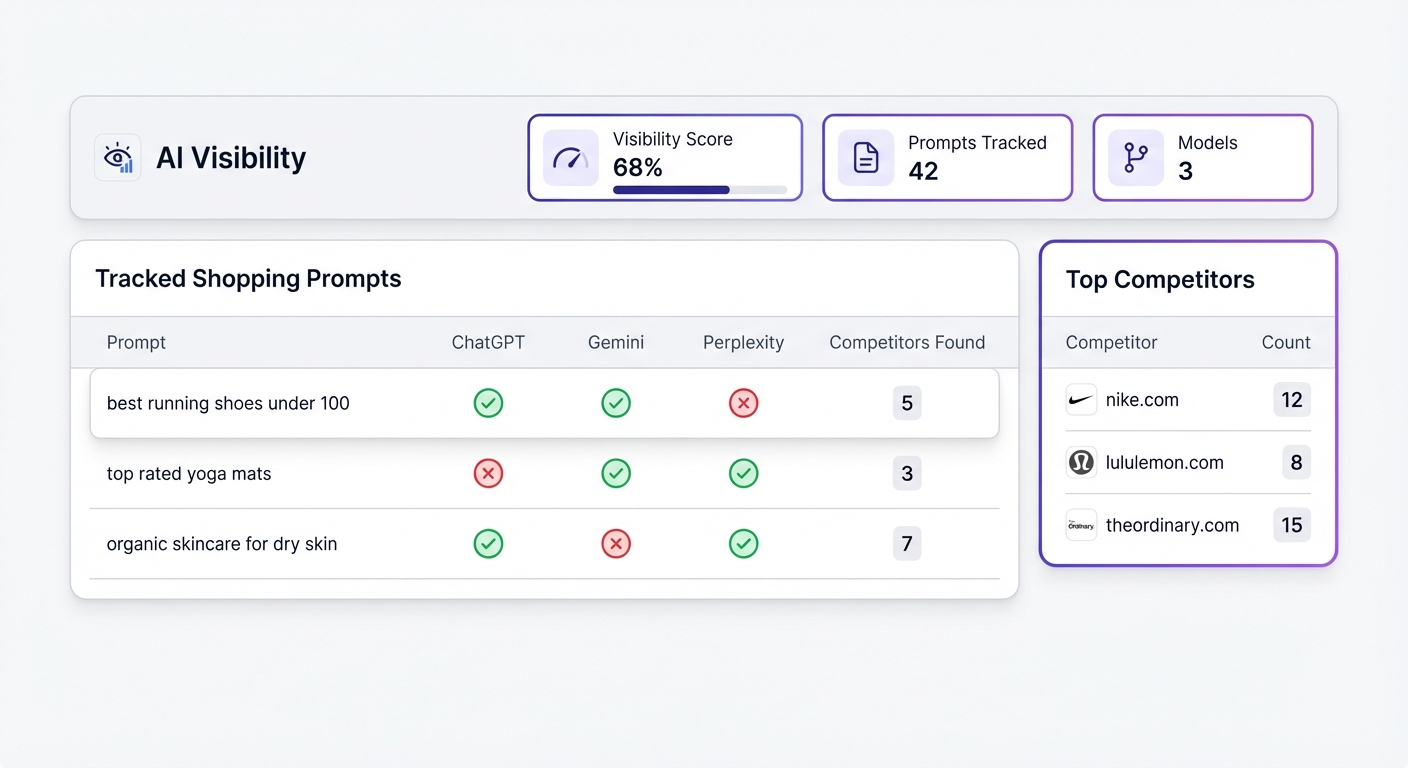
Once the technical layer is in shape, prompt monitoring becomes valuable. The platform then tests realistic buyer language across multiple assistants and watches what appears over time.
The important part is prompt design. Good platforms don't only test branded prompts. They also test category, comparison, budget, use-case, and attribute-driven prompts such as:
- Budget prompt: “Best running shoe under $100”
- Use-case prompt: “Best office chair for long workdays”
- Comparison prompt: “Nespresso vs Breville for small kitchens”
- Attribute prompt: “Best waterproof diaper bag with stroller straps”
The platform allows product teams, SEO teams, and merchandisers to finally work from the same view of discovery.
AI referral and traffic analysis
The fourth capability is often underbuilt. The platform should show whether AI systems and AI referrals interact with the site, which pages they reach, and where that activity is clustering.
That does two jobs. First, it validates whether your visibility work maps to real storefront activity. Second, it helps teams spot pages that are already attracting AI attention and deserve better product content, cleaner schema, or stronger internal linking.
One option in this category is SearchMention, which combines an AI readiness scan with product-level prompt tracking and AI traffic monitoring for online stores. The point isn't that every retailer needs the same vendor. The point is that the platform needs to connect technical readiness, answer visibility, and observed site activity in one workflow.
How to Evaluate and Choose a Platform
The easiest way to buy the wrong AI visibility platform is to shop the dashboard instead of the diagnosis. Many products look convincing in a demo because the charts are clean and the prompt reports are easy to understand. For e-commerce, that's not enough.
Start with what the tool validates before it reports
A major gap in this market is technical readiness for e-commerce catalogs. Profound notes that most AI visibility discussion focuses on citations while giving less practical attention to whether crawlers can read product schema correctly, and the implication is clear: prioritize indexability and data fidelity before buying more monitoring, as discussed in Profound's guide to choosing an AI visibility provider.
That's exactly the right lens for retail.
If a platform can't help you assess product schema, renderability, and bot access, it's mostly telling you the score after the damage is done. A beauty retailer with incomplete structured product data won't fix recommendation gaps by buying more prompt volume. A marketplace seller with blocked or inconsistent bot access won't solve ingestion issues through sentiment charts.
Here's a practical checklist to use in demos.
| Capability | Question to Ask | Why It Matters |
|---|---|---|
| Technical readiness | Does the platform audit bot access for major AI crawlers and assistants? | You need to know whether systems can reach product pages at all. |
| Product schema validation | Can it verify name, price, availability, brand, reviews, and SKU fields on PDPs? | AI recommendations depend on readable product facts, not page design alone. |
| Prompt testing | Does it track non-branded buyer prompts across multiple models? | Retail discovery often starts with category and use-case language. |
| Recommendation analysis | Can it separate a passing mention from an actual product recommendation? | Mention count can inflate perceived performance. |
| Competitive visibility | Does it show which products or competitors appear when yours do not? | Missing context makes optimization guesswork. |
| Referral telemetry | Can it show AI-related referrals or observed bot activity on the site? | You need evidence that visibility work maps to site activity. |
| Operational workflow | Does it produce prioritized fixes for marketers, developers, and merchandisers? | Retail teams need action lists, not just diagnostics. |
Questions worth asking in the demo
Don't ask the vendor only which models they cover. Ask how they handle the messy parts.
- Ask for a crawl explanation: Which pages are accessible, which are not, and how do they know?
- Ask for product-level proof: Can they show whether a single SKU or PDP appears in responses?
- Ask how they treat inconsistency: AI outputs vary. What does the platform do beyond one-off snapshots?
- Ask for developer usefulness: Will your engineering team get a real worklist, or just screenshots and scores?
If you want a broader comparison set before shortlisting vendors, SearchMention's roundup of AI search optimization tools is a practical place to compare categories of functionality.
The right platform should help your team fix the store, not just observe the problem.
A Practical Implementation Roadmap for E-commerce Teams
The teams that make progress here don't start with a giant transformation program. They start with a narrow diagnostic, fix obvious blockers, then expand monitoring where it matters.

Phase 1 baseline assessment
Start with a small sample of priority pages. Pick a handful of PDPs, one or two category pages, and a few high-intent prompts that map to real buying behavior.
Look for basic failures first:
- Blocked access: AI bots can't consistently reach templates or page types
- Broken product data: Missing or inconsistent price, availability, or brand fields
- Weak entity clarity: Product names and variants create confusion
- Answer absence: Your products don't appear for obvious category or comparison prompts
This baseline gives you a before state without forcing the whole organization into a new workflow on day one.
Phase 2 fix access and data issues
Next, clean up the obvious technical blockers. This usually means coordination between SEO, development, and merchandising.
Typical fixes include schema cleanup, improving consistency across product fields, resolving rendering issues, and making sure important pages are accessible to relevant crawlers. For stores on Shopify, Magento, or headless setups, implementation detail matters more than theory.
Retailers usually gain more from fixing broken product data than from adding another reporting dashboard.
Phase 3 begin monitored prompt coverage
Once the foundation is cleaner, expand into ongoing prompt tracking. Start with categories where discovery language is clear and purchase intent is strong.
A practical seed set often includes:
- Category prompts: broad terms tied to merchandise groups
- Use-case prompts: “best for” queries tied to need states
- Budget prompts: threshold-based shopping language
- Comparison prompts: brand-vs-brand and product-vs-product terms
The point isn't to monitor everything at once. It's to build a stable set your team can review regularly and act on.
Phase 4 connect visibility to site activity
The last phase is operational. Tie answer visibility back to observed bot activity, referrals, and page-level storefront behavior.
Teams then begin to spot patterns. One category may get cited often but send little useful traffic. Another may have modest mention rates but strong downstream engagement. A third may remain absent because the catalog data is still messy. That's the kind of signal an AI visibility platform should surface.
Your First Steps Toward AI Visibility
Most retailers don't need to start by buying the broadest platform on the market. They need to start by finding out whether AI systems can reliably access and understand their product catalog.
That means your first step is simple. Audit technical readiness before you obsess over prompt coverage. Check bot access. Validate schema. Look at whether price, availability, reviews, brand, and SKU fields are readable and consistent. Then test a focused set of prompts that mirror how customers shop.
If you want a useful technical starting point, this guide on how to optimize product schema for ChatGPT shopping is worth reviewing with both your SEO lead and your developer. It gets to the part many teams skip.
The main shift is organizational, not just technical. AI visibility sits between merchandising, SEO, analytics, and development. If one team owns it alone, progress usually stalls. The retailers that move fastest treat it like a measurable acquisition surface with technical prerequisites, not a branding experiment.
An AI visibility platform is valuable when it helps your team answer three practical questions. Can AI systems read our store? Do our products appear for the prompts that matter? What should we fix next? If a tool can't answer those in order, it's probably not the right one for e-commerce.
SearchMention helps online stores turn AI discovery into something measurable and fixable. You can start with the SearchMention platform to run an AI readiness scan for catalog access and schema, then track how products appear across buyer prompts and which AI systems are reaching your storefront.
Find out where you stand in AI search
SearchMention tracks which of your products show up in ChatGPT, Gemini, and Perplexity — and shows you the prioritized fixes.
Scan My Site Free