ChatGPT Rank Tracker: What "Rank" Actually Means, and How to Track It (2026)
There are no ranking positions inside ChatGPT — which makes "rank tracking" the wrong mental model and explains why so many tools disappoint. Here are the four things you can actually measure, a free way to do it by hand, and an honest look at the tools.
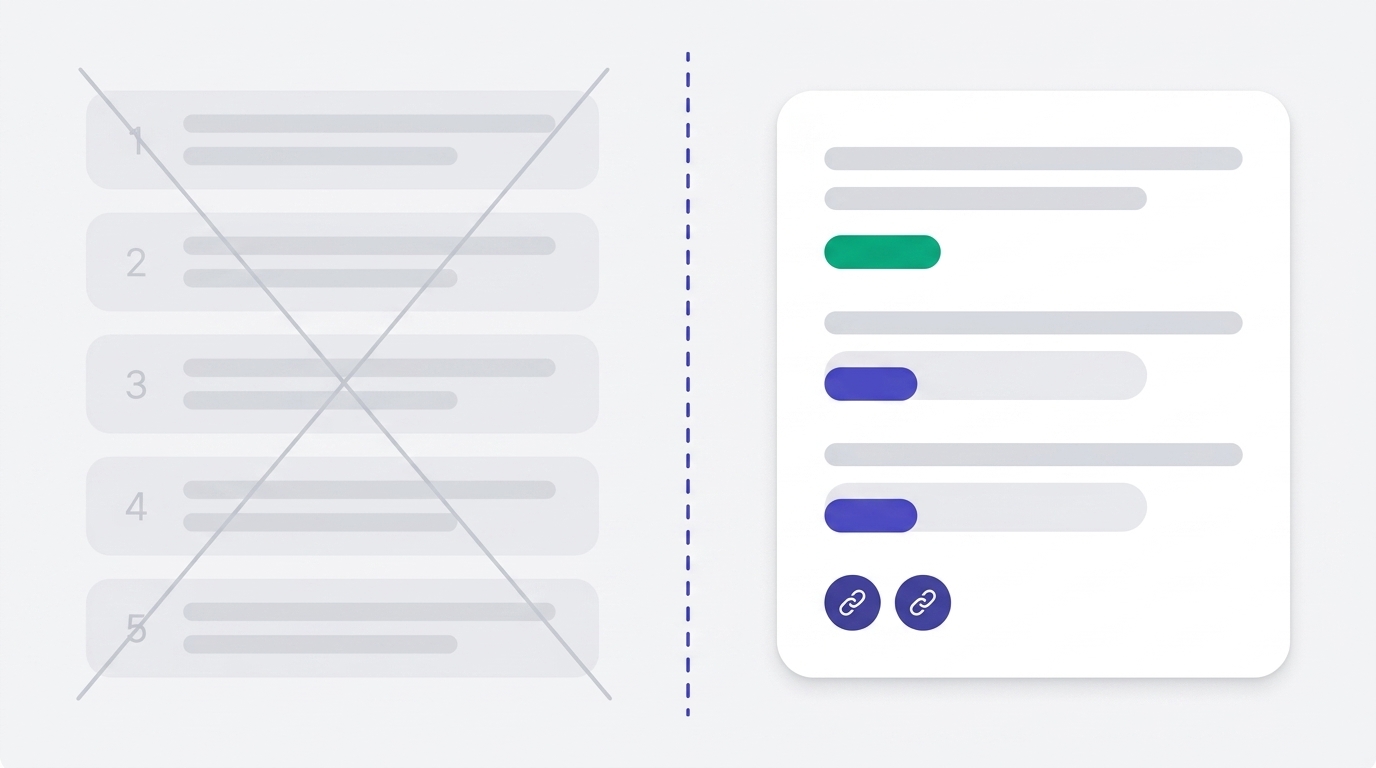
There is no rank — track mention rate instead
SearchMention tracks ChatGPT mention rate, position within the answer, and which product URL got cited — the metrics that actually behave like ranking over time.
See how SearchMention worksIf you searched for a ChatGPT rank tracker, you are trying to answer a completely reasonable question: am I showing up when people ask ChatGPT about my category, and is that getting better or worse? That question is worth answering. The word "rank" is just the wrong tool for it, and starting from the wrong model is why a lot of people buy something and then can't tell whether it's working.
Google gives you an ordered list of ten results, so rank is a real number you can look up. ChatGPT gives you one written paragraph that might name three brands and link two sources. There is no second position. There is no page two. You are either in the answer or you are not, and the difference between "mentioned first" and "not mentioned" is most of the value.
So the useful question isn't "what's my rank in ChatGPT". It's four narrower questions, each of which you can genuinely measure — and once you're measuring those, the tooling decision gets much easier.
TL;DR
- ChatGPT has no ranking positions, so there is no rank to track. Track mention rate, position within the answer, share of voice, and which URL got cited.
- Mention rate across a fixed set of prompts is the metric that behaves most like a ranking over time. It is the one to put on a dashboard.
- You can do this free by hand in about 20 minutes a week with a spreadsheet and a logged-out ChatGPT session.
- Answers vary by user, session, region and model version — so sample repeatedly and never trust one screenshot.
- Keep your prompt list identical between runs. Change the prompts and the trend line becomes meaningless.
- Pay for a tool when the manual version starts eating an hour a week, not before.
The four metrics that replace "rank"
Every credible ChatGPT tracking setup, manual or paid, comes down to these four. If a tool can't show you all four, you'll hit its ceiling quickly.
1. Mention rate. Out of the buyer questions you care about, what percentage produce an answer that names you? This is the closest thing to a ranking, because it's a rate rather than a single observation, so it survives the fact that individual answers wobble. If you track 20 prompts and get named in 6, your mention rate is 30% and that number is comparable week to week.
2. Position within the answer. When you are named, are you the first recommendation or the fourth? Being listed first in a three-brand answer is worth far more than being the last of six, and this is the closest analogue to a classic ranking position. It's also the metric most people forget to record.
3. Share of voice. Across all your tracked prompts, what fraction of all brand mentions are you versus each competitor? This is what tells you whether you're losing to one dominant rival or to a scattered field — a completely different problem with a completely different fix.
4. The cited URL. When the answer links a source, which page is it? This is the most actionable of the four, because it tells you which page is doing the work. Often it isn't the page you'd expect: a comparison post or a category page frequently earns the citation while the product page you optimised gets ignored.
A fifth thing is worth recording even though it isn't a metric: which competitors got named instead of you. A prompt where you're absent and one rival appears every single time is a much more urgent signal than a prompt where five brands rotate randomly.
Track it free by hand (about 20 minutes)
Do this before you pay for anything. It costs nothing, it takes one sitting, and it tells you whether you have a problem worth automating.
Write 10–20 buyer questions. Phrase them the way a customer would, not the way you'd write a keyword. "Best waterproof hiking boots for wide feet" is a real prompt; "hiking boots" is not. Include a few that name your category plus a constraint (price, use case, size, material), because that's how people actually ask. Do not include your own brand name — a question that names you is not a test.
Use a clean session. Log out, or turn off memory and custom instructions. Your own account has been reading about your brand for months and will happily tell you what you want to hear.
Record five columns per prompt. Date, prompt, were you mentioned (yes/no), which competitors were mentioned in order, and which URLs were cited. That's the whole schema. Mention rate falls out of column three, share of voice out of column four, and your best-performing pages out of column five.
Re-run the identical list weekly. The discipline that matters is not changing the prompts. It's tempting to swap in better-phrased questions as you learn, but the moment you do, you've reset your baseline and the trend is fiction. Keep a separate list for new prompt ideas and start their history from zero.
How to track ChatGPT rankings over time
This is where most manual efforts fall apart, and it's worth understanding the failure mode before you pick a cadence.
ChatGPT answers are not deterministic. The same question can produce different brands depending on whether the model decided to run a web search, what your account remembers, your region, and which model version served you. So a single answer is one sample from a distribution, not a measurement. Two people comparing screenshots and disagreeing are usually both right.
The practical consequence: never act on one answer, and never act on one prompt. A single prompt flipping from mentioned to not-mentioned is noise. Your mention rate across 20 prompts dropping from 40% to 15% over three weeks is signal. This is also why the tools that only check a handful of prompts on a free tier feel unconvincing — the sample is too small to move.
Weekly is the right default. Daily produces noise you'll misread as movement and burns API budget; monthly is too slow to connect a change you shipped to a change in the numbers. Weekly, on a fixed day, with a stable prompt list.
Also record what you changed and when. The whole point of tracking is to connect a fix to an outcome, and citation shifts lag content changes by days to weeks — the model has to re-crawl and re-form its picture of your category. Without a change log you'll have a trend line and no idea what caused it.
What to look for when the manual version stops scaling
Automate when the spreadsheet costs you an hour a week, or when you need more prompts than you'll patiently paste by hand. Then judge tools on five things:
- Does it record all four metrics, or only "mentioned yes/no"? Mention-only tools are the most common disappointment — they tell you something is wrong without telling you what to do.
- Does it name the competitor that won when you're absent, including brands you never told it about? Discovering an unexpected rival is often the single most valuable output.
- Does it attribute citations to specific URLs, so you know which page earned the mention? This is what turns tracking into a to-do list.
- How many prompts and engines does the tier you can afford actually cover? Prompt count is the real unit of cost, and thin tiers produce statistically useless samples.
- Can you export the raw answers? Reading the actual prose is how you learn why you lost. A dashboard that only shows scores hides the reasoning.
One thing not to over-weight: the number of AI engines supported. Tracking six engines badly is worse than tracking ChatGPT well, and for most sites ChatGPT is where the traffic actually comes from. On our own site, 194 of 199 AI referrals in a recent 28-day window came from ChatGPT — we wrote up the full numbers here, including the 9 Google clicks we got over the same period.
ChatGPT rank tracking tools, compared honestly
We make one of these, so treat our summary of ourselves with appropriate suspicion. This is the short version focused on ChatGPT tracking specifically — our full comparison of 12 AI search optimization tools has the detailed reviews, pricing caveats and weaknesses for each.
| Tool | Best for | Free tier | From |
|---|---|---|---|
| SearchMention | Stores tracking product-level citations | Yes — free readiness scanner + prompt taste | $29/mo |
| Promptwatch | Brands and agencies, many models | Yes — 10 prompts, ChatGPT | Tiered / custom |
| Otterly.ai | SaaS and mid-market brand tracking | Trial | ~$29/mo |
| Peec AI | Marketing teams and agencies | Trial | €89/mo |
| Profound | Enterprise brand intelligence | Demo only | Custom (~$5K+/mo) |
| IndexGPT | Shopify indexing plumbing, not tracking | 3-day trial | Shopify App pricing |
The honest guidance: if you track a brand name and want breadth across many models, Promptwatch or Otterly will serve you better than we will. If you have enterprise budget and need board-ready category intelligence, that's Profound. If you're on Shopify and your actual problem is getting pages indexed rather than measuring mentions, IndexGPT is solving a different and legitimate problem.
We're the right answer in one specific case: you sell products, and "was my brand mentioned" is too coarse because what you need to know is which of your 400 SKUs the model recommends. That's a different data model, not a different dashboard.
If you sell products, brand-level tracking isn't enough
A software company has one thing to track: the company name. A store with 400 products has 400 things to track, and a mention rate averaged across the catalogue tells you almost nothing useful.
The questions that matter are product-shaped. Which specific items get recommended, and which never surface at all? When a buyer asks for "the best X under $200", does the model name your product or a competitor's? Which of your product pages actually earned the citation — because it's frequently a category page or a comparison post rather than the SKU page you optimised.
This is where a brand-level tracker leaves you stuck. It will tell you your mention rate went from 30% to 25% without telling you that one product line stopped surfacing entirely. The fix is different too: for products it usually comes down to structured data, review coverage and comparison content, which we walk through in the Shopify AI search optimization checklist.
Worth checking before any of it: whether the crawlers can read your pages at all. Plenty of stores block them accidentally through a theme default or a security plugin, and if GPTBot and OAI-SearchBot can't fetch your site, no amount of tracking will help.
Once ChatGPT is handled
ChatGPT is the hardest engine to audit because it often paraphrases without showing sources. Perplexity is the opposite — it footnotes every claim with a visible sources panel, which makes it the best place to learn what "getting cited" looks like before you try to infer it from ChatGPT. Our Perplexity tracking guide covers that, and the multi-engine citation guide covers Gemini and Google AI Overviews.
For transparency about where we sit: our own mention rate across the prompts we track for ourselves is currently 33%. We publish that because a tracking tool claiming perfect visibility would be the least believable thing on this page.
Frequently asked questions
Does ChatGPT have rankings like Google?
No. There is no ranked list of results in ChatGPT and no position 1 through 10. ChatGPT returns one written answer that may name a few brands and link a few sources. So there is no rank to track. What you can track is whether you get named at all, how early in the answer you appear relative to competitors, what share of the named brands are you versus rivals, and which of your URLs the model cited.
How do I track my rankings on ChatGPT over time?
Fix a list of buyer questions and re-run exactly those questions on a fixed schedule, recording for each one whether you were mentioned, which competitors were mentioned, and which URLs were cited. Weekly is enough for most sites. The list of prompts must stay stable between runs — if you change the questions you change the measurement, and any trend you see is meaningless. Because ChatGPT answers vary between users and sessions, treat each run as a sample and watch the rate across many prompts rather than any single answer.
Is there a free ChatGPT rank tracker?
You can track it free by hand: write down 10 to 20 buyer questions, ask them in a logged-out ChatGPT session, and record mentions, competitors and cited links in a spreadsheet. That costs nothing and takes about 20 minutes per run. Free automated starting points exist too — SearchMention's free AI readiness scanner (no signup) checks whether AI engines can read your store, and the free plan includes a taste of prompt tracking on ChatGPT. Promptwatch has a free tier covering 10 prompts on ChatGPT. Fully free unlimited automation does not really exist, because every check costs the provider an API call.
What is a ChatGPT mention tracker?
The same thing as a ChatGPT rank tracker, named more accurately. Because ChatGPT has no ranking positions, the measurable event is a mention — your brand or product being named in an answer — and optionally a citation, where the answer links to your page. Mention rate across a fixed prompt set is the metric that behaves most like a ranking over time.
Why do I get different ChatGPT answers than my colleague for the same question?
Answers vary by account memory and custom instructions, by whether the model chose to run a web search, by region, and by model version. That is why a single screenshot proves nothing and why any tracker worth using samples repeatedly. Use a logged-out or memory-disabled session for manual checks so your own history does not contaminate the result.
Can I use Ahrefs or Semrush to track ChatGPT rankings?
Not for the core metric. Traditional rank trackers query a search engine results page and read positions, which does not exist in ChatGPT. Both vendors have added AI-visibility features, but the underlying job is different: instead of scraping a SERP you have to ask the model questions and parse prose for brand names and links. If you already pay for one, check what its AI module covers before buying a dedicated tool.
Next steps
- Run a free AI readiness scan to confirm ChatGPT can even read your store.
- Write your 10–20 buyer prompts and record the first week by hand — you need a baseline before you need a tool.
- Confirm the AI crawlers can reach you with the robots.txt guide.
- Compare tools properly in the 12-tool breakdown once the manual version stops scaling.