Why ChatGPT Links Your Product to Another Store (and How to Fix It)
Being recommended is half the job. The other half is where the link sends the buyer, and in the reports we read, it is often not the brand's own store.
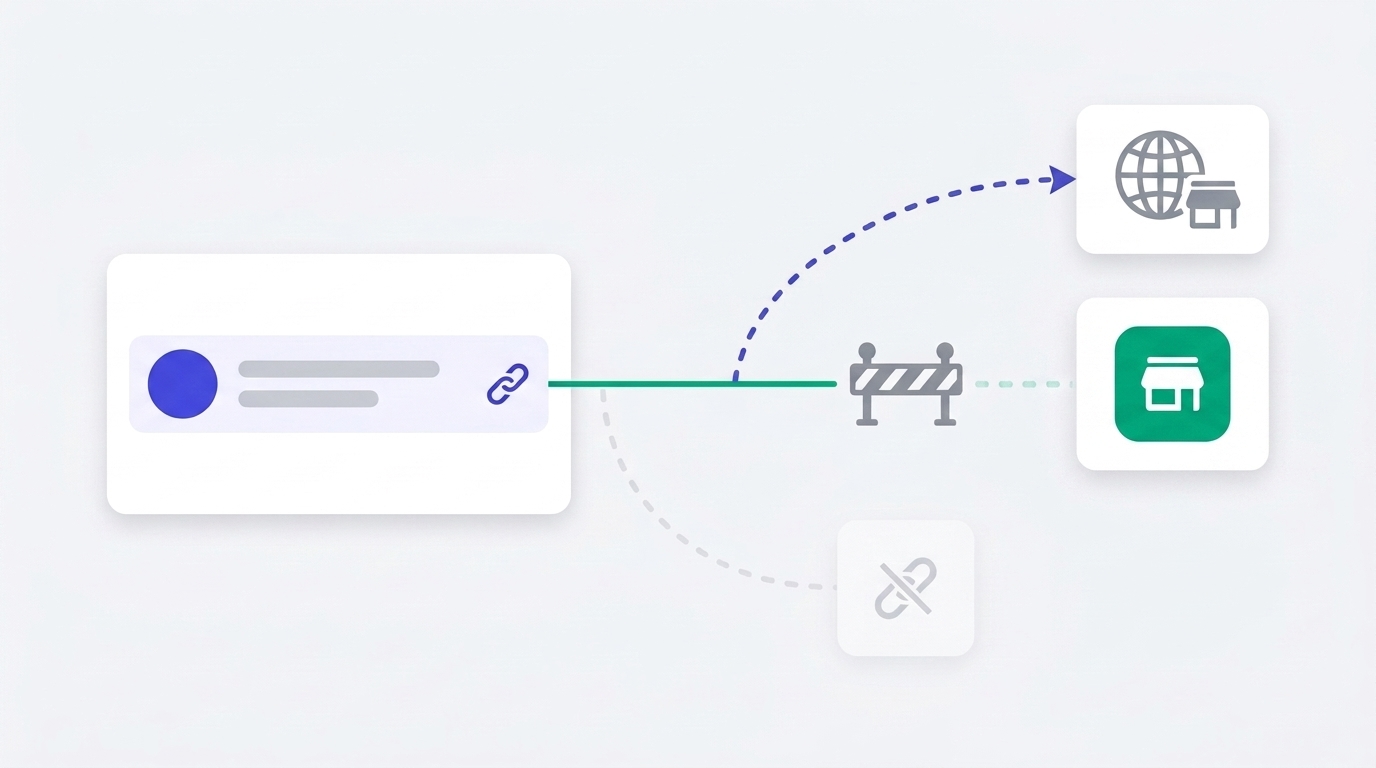
Start with your own product pages
The free AI readiness scan checks whether AI crawlers can read your product pages and whether your Product markup carries price, currency and availability: the facts AI needs to pick your page over a reseller's.
Scan My Site FreeWhy does ChatGPT link my product to another store? Because ChatGPT chooses the product and the link separately: it names your product from what it read, then attaches a page it found that sells it, and that page can belong to a reseller, a marketplace, another country's storefront, a discontinued listing or a company that shares your name. OpenAI says it ranks merchants on availability, price, quality and whether they are the maker or primary seller, so when your own page isn't the clearest current option for that shopper, someone else's gets the click.
We see this in the AI visibility reports we run for small online stores. A brand is ChatGPT's first recommendation, and the link under its name goes to a shop in Chile, an Indian marketplace or a page that was taken down. The recommendation is real. The sale, if it happens, goes somewhere else. Across 404 buyer questions we ran for 27 small online stores, when ChatGPT named the store, 63% of the product links it attached to that store went somewhere other than the store's own website.
This is a different problem from products not showing up in ChatGPT at all. Here you are showing up. Below are the five patterns we keep finding, each checked against the raw ChatGPT answer, and the fix for each, checked against Google's, OpenAI's and Shopify's current documentation (October 2026).
TL;DR
- Every product in a ChatGPT answer has two links: a product link and a source link. Check both; they often go to different sites.
- Five patterns: a reseller abroad, a marketplace page in another currency, a discontinued listing, a same-name company, and a reseller page reused for another brand.
- Make your page the best candidate: brand and product name in the title, Product + Offer markup with
price,priceCurrencyandavailability. - Feeds: Google Merchant Center links must use your verified domain; OpenAI accepts direct product feeds; Shopify stores already reach ChatGPT through Shopify Catalog.
- Markets: one URL per country with its own currency; avoid forced IP redirects that hide versions from crawlers.
- Old URLs and names: 301 old domains and discontinued products for at least a year; make your Organization markup and brand naming unambiguous.
First, count the links correctly
When ChatGPT lists products in a search answer, each one usually comes with two links. The product link is attached to the product title, and it's the one a shopper clicks to buy. The source link sits underneath, in the small citation that says where the description came from. They are chosen separately, and they often point to different sites.
A camping lantern brand we checked was ChatGPT's first pick for "best telescoping lanterns for camping", and four of the five products in that answer were theirs. Counting product links: three went to a Chilean outdoor retailer's Spanish-language pages, one to an Australian retailer, and one to the brand's own store. Counting source links: all five went to the brand's homepage. If you only look at sources, the answer looks like a win. If you look at where a buyer lands, 4 of 5 clicks leave the country.
So the first habit: when you test your products in ChatGPT, open every product link, not just the sources, and write down the domain and country of each.
Five patterns from real reports
Each example below comes from a report we ran in late September 2026, and each was re-read against the raw ChatGPT answer before we wrote it down. The stores are anonymized.
| Pattern | What ChatGPT did | Where to fix it |
|---|---|---|
| Reseller abroad | #1 lantern brand: 4 of 5 product links to retailers in Chile and Australia | Markets, feeds, reseller pages |
| Marketplace, other currency, other product | #1 court jacket linked to a men's jacket on an Indian marketplace | Product page, product naming |
| Discontinued listing | #1 dry-eye supplement linked to a discontinued iHerb Brazil page | Marketplace listings, feed, availability |
| Same-name company | Bike bags linked to an infrastructure contractor's domain; both pages 404 | Domain, Organization markup, naming |
| Reseller link reused | Halal gummies linked to a reseller in Oman, twice, once under another brand | Feeds, product page clarity |
1. The reseller abroad
The lantern case above. The brand sells through distributors in other countries, and those distributors publish one clean page per product: the model name in the title, specs, a price, a buy button. ChatGPT found those pages and attached them to the products it recommended to a shopper who asked in English. The brand's own source pages were all its homepage, not its product pages, which suggests the model had an easier time reading the distributors' product pages than the brand's.
2. A marketplace page in another currency, for a different product
A small activewear brand was ChatGPT's first pick for "eco-friendly performance jackets for court sports". The product link went to an Indian fashion marketplace, priced in rupees, and the page there was a men's jacket from a celebrity line with a similar name. The source link went to a US department-store reseller. The brand's own site wasn't linked anywhere in the answer. Generic product names ("performance jacket") make this kind of mix-up easier: the model matched words, not the product.
3. A discontinued listing
A supplement brand was ChatGPT's first pick for "best oral hyaluronic acid supplement for dry eyes". The source link was right: the brand's own product page. The product link went to iHerb's Brazilian store, with a Portuguese title and a price in reais, and when we opened it the page said the item was discontinued and returned HTTP 410 (gone). A buyer who clicks gets a dead end, on the wrong continent, for a product the brand still sells on its own site.
4. A company with the same name
A Canadian bike-bag maker was recommended in ChatGPT's answers for "best bike panniers for commuting to work" and "best pannier for carrying a laptop". In both, ChatGPT gave a plain URL on the .com of the brand name. That domain belongs to an unrelated infrastructure contractor, and both URLs return 404. The paths looked like real store paths (/collections/panniers), which is the tell: the model assembled a plausible URL from the brand name and a common domain pattern rather than copying a link it had found. The maker's real store is on a Canadian domain.
5. One reseller link, reused
A halal supplement brand was second in ChatGPT's answer for "best halal multivitamin gummies for adults". Its product link went to a cross-border reseller's site in Oman. The same Oman link then appeared again under a different brand's gummies further down the list. Google's AI Overviews, for the same brand's children's products, linked Amazon listings. None of these are wrong in the sense of being fake: the resellers do sell the product. They are just not the store that wants the customer.
Why it happens
OpenAI's help page on shopping in ChatGPT (checked October 5, 2026) explains the mechanics in plain terms. ChatGPT considers structured metadata from first-party and third-party providers, such as price and description. When it lists merchants for a product, it ranks them on factors like availability, price, quality and whether they are the maker or primary seller. Prices in the first response typically come from the first merchant listed, which may not be the cheapest.
Read that list as a checklist for your own page. Being the maker is a factor, but it is one of four. A reseller page that is in stock, priced in a clear currency and easy to parse can beat a brand page that is slow, thin, redirected by location or missing price data. And when there's no page at all, as in the same-name case, the model can still write a URL.
Profound's analysis of 22.5 million ChatGPT buy offers (March 2026) points the same way from the other side: the top 20 merchants accounted for about 40% of all offers, whichever brand's product was being recommended. Broad catalog coverage puts big retailers in front of the model more often than a brand's own store.
How to fix it, step by step
You can't pick the link ChatGPT uses. You can make your page the obvious candidate and remove the bad alternatives you control. In order of impact:
1. Make each product page the maker's page, in machine-readable form
Put the brand and the product name together in the page title and H1 ("Brand Trail 2000 telescoping lantern", not just "Trail 2000"). Make sure the page carries Product structured data with an Offer: price and priceCurrency (three-letter ISO 4217, such as USD) are required for Google's merchant listings, and availability and url are recommended. Shopify, WooCommerce and Magento themes all output some of this; check that it's complete on your bestsellers. Our product schema guide has the full markup.
Google is clear that structured data isn't required for its generative AI features and that no special markup exists for them. It still helps every system that reads your page agree on the product, the price and the currency, which is exactly what a reseller page usually does better.
Also confirm that AI crawlers can reach the page at all. OpenAI's documentation says sites that block OAI-SearchBot won't be shown in ChatGPT search answers, though they can still appear as navigational links. A blocked brand page with an open reseller page is the lantern case waiting to happen. See how to allow OpenAI crawlers.
2. Fix your product feeds
Google Merchant Center. The product data specification says the link must use your verified domain, and the price must match your landing page, structured data and checkout, in the currency of the target country. Only submit your own name as brand if you make the product. Google's guide to AI features lists Merchant Center feeds as a way to make products visible in AI responses, and in the Google answers we read, recommended products are often backed by Google Shopping listings.
OpenAI. Merchants can apply at chatgpt.com/merchants to send a product feed directly. Required fields are item_id, title, description, url, brand, seller_name, image_url, availability and price, with price written as amount plus currency code ("79.99 USD"). The shared format currently covers the US, Canada and Mexico as target countries. OpenAI's help page also says Shopify merchants are already integrated through Shopify Catalog, with no extra work required, so on Shopify the job is keeping your catalog data clean rather than building a feed.
3. Give every market its own URL and currency
If you sell in several countries, each one needs a page a crawler can reach directly. Shopify Markets lets you use subfolders (example.com/en-ca), subdomains or country domains, and Shopify's help center says it creates hreflang tags for every international domain or subfolder automatically, and calls subfolders the best option if you're setting up international selling for the first time. WooCommerce and Magento stores can do the same with store views or a multilingual plugin; check that hreflang is actually output, because that depends on the extension you use.
Be careful with automatic redirects. Google's guidance for multi-regional sites says to avoid redirecting users by guessed location or language, because crawlers usually come from the US and may never see the other versions. If your Canadian or Australian page only exists behind a geo-redirect, a distributor's page in that country is the only one a crawler can read.
4. Clean up reseller and marketplace listings
You can't control every reseller, but you can usually influence the authorized ones and your own marketplace accounts:
- Ask distributors abroad to label their pages with their country and currency and to link to your brand site.
- Keep your own marketplace listings (Amazon, iHerb, Walmart) current, and have discontinued listings closed rather than left as dead pages with your brand in the title.
- Give resellers your exact product names and descriptions, so their pages and yours describe the same product the same way.
5. Redirect old domains and discontinued products
If you moved from one domain to another, or retired a product, redirect the old URLs. Google recommends permanent redirects (301 or 308) and keeping them for as long as possible, generally at least a year. For a discontinued product, point the old URL at its replacement, or keep the page live with availability marked Discontinued and a link to the successor. A 404 on your side makes the reseller's old copy the best page left.
6. Make your brand unambiguous
For same-name collisions, add Organization structured data to your homepage. Google says it helps disambiguate your organization; include url, logo, sameAs links to your social and marketplace profiles, and legalName or alternateName if they differ from your brand. Use the same "brand + category" phrasing everywhere ("Brand bike bags", not just "Brand"). If you own other domain variants (the .com when you trade on a country domain), redirect them to your store. If you don't own them, the clarity of your own pages is the defense.
How to keep checking
Answers change between runs, so one test tells you what happened once. A simple routine works:
- Pick 10 to 15 buyer questions your customers actually ask, in their words, about the products you sell.
- Ask them in ChatGPT with search on, and in Google, where AI Overviews appear.
- For each product of yours that is named, record the product link domain, the source link domain, the country and the currency.
- Open every link. Note 404s, 410s, discontinued pages and redirects to other sites.
- Repeat monthly, and after any fix, to see whether the link moved to your store.
Doing this by hand gets slow past a few products. SearchMention reports show which domain each product link and each source link goes to, per question and per engine, and flag links to your own pages that are broken. Profound (its merchant layer) and Peec (top merchants and shopping source visibility) also report link destinations, so pick whichever fits your store and budget. For the general method of tracking sources, see how to track AI search citations.
Frequently asked questions
Why does ChatGPT link my product to another store?
It picks the product and the link separately, and OpenAI ranks merchants on availability, price, quality and whether they are the maker or primary seller. If a reseller's page is clearer or more current for that shopper, it gets the link even when your product is the recommendation.
Why does it link a store in another country or currency?
A distributor abroad often has the most readable product page. Give each market its own URL and currency, avoid forced IP redirects, and include price and priceCurrency in your Product markup.
Can I make ChatGPT link to my own website?
Not directly. Make your page the best candidate: crawlable, brand and product name in the title, complete Offer data, a Merchant Center feed on your verified domain, and a direct OpenAI feed if you qualify. Shopify stores are already connected through Shopify Catalog.
Why does it link a company with the same name?
Plain URLs in an answer can be assembled from your brand name and a common domain. Make your domain and Organization markup unambiguous, and redirect domain variants you own.
How do I check which store ChatGPT links?
Ask real buyer questions with search on and open every product link and source link, counted separately. In one answer, 4 of 5 product links went abroad while all 5 sources went to the brand's homepage.
See where AI sends your buyers
SearchMention asks ChatGPT and Google the questions your shoppers ask and shows, for each product, whether the link goes to your store, a reseller, a marketplace or another country's storefront.
See how AI Visibility works