Agentic Commerce Before Black Friday: What Stripe's Data Means for Online Stores (2026)
AI agents are already buying, and a third of what they spend goes to retail. Payment is the easy part. The store is chosen before the agent pays.
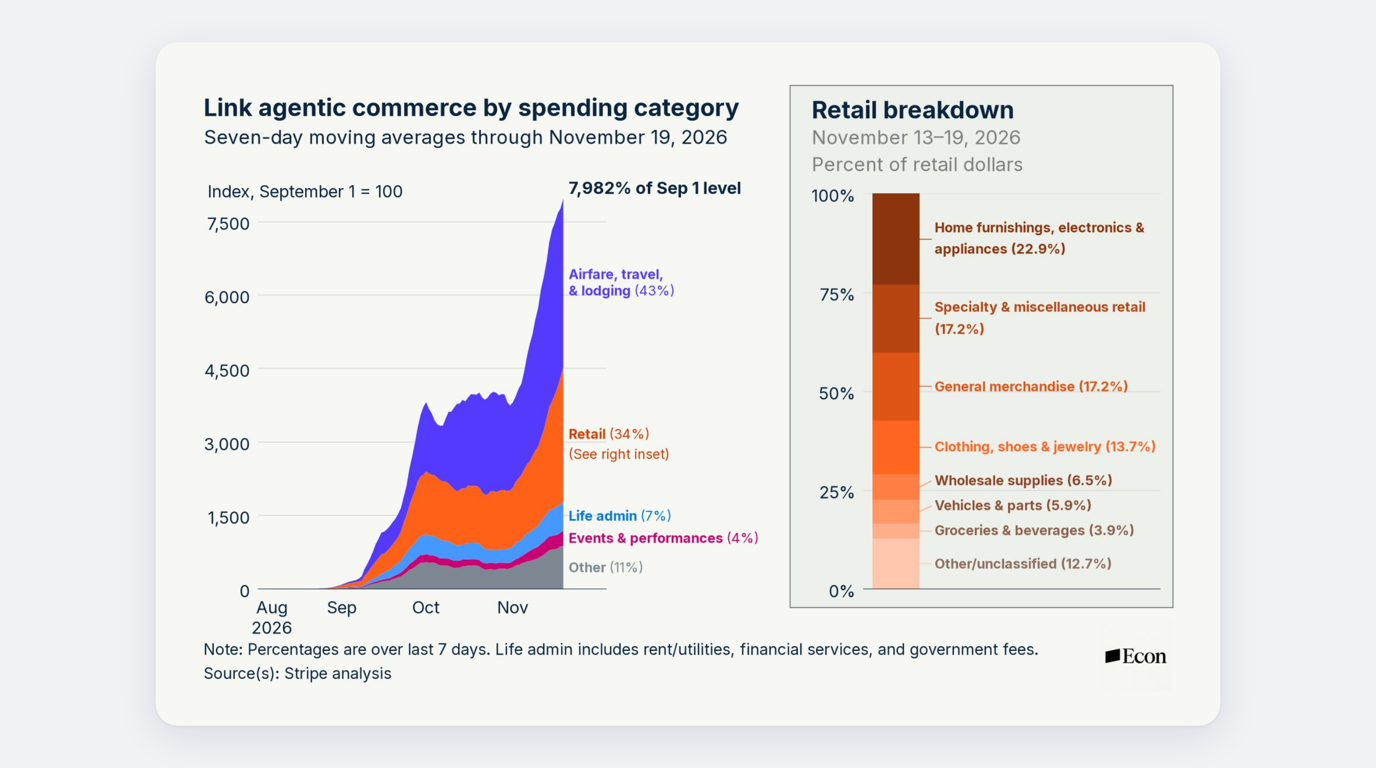
What did Stripe report about agentic commerce? On November 20, 2026, Stripe's chief economist Ernie Tedeschi shared early data in an article on X, from Link's wallet for agents, the wallet personal AI agents such as Muse, Instinct and Grok use to pay. Daily spending was nearly 80 times higher in mid-November than at the start of September, and it doubled in the last month alone. 43% went to travel, 34% to retail, led by home furnishings, electronics and appliances. 56% of the people who bought once through an agent bought again, and the more they bought, the more likely they were to buy again.
For an online store, the useful part isn't the payment. A one-time card from an agent wallet goes through your checkout like any other card. The part that decides whether you get the sale happens earlier: the agent searches, reads product pages and compares stores, then pays the one it picked. This is the first holiday season with agents shopping at that scale, so it's worth checking what they see before Black Friday.
Ernie Tedeschi (Stripe): The agentic story on the eve of the 2026 holiday season.
Read it on X, November 20, 2026
TL;DR
- Fast growth, unknown size: agent spending on Link rose about 80-fold since September, but Stripe shared no dollar amounts.
- Retail is a third of it: travel leads with 43%, then retail at 34%. Within retail, home furnishings, electronics and appliances lead (22.9%), then general merchandise and specialty retail (17.2% each), then clothing, shoes and jewelry (13.7%).
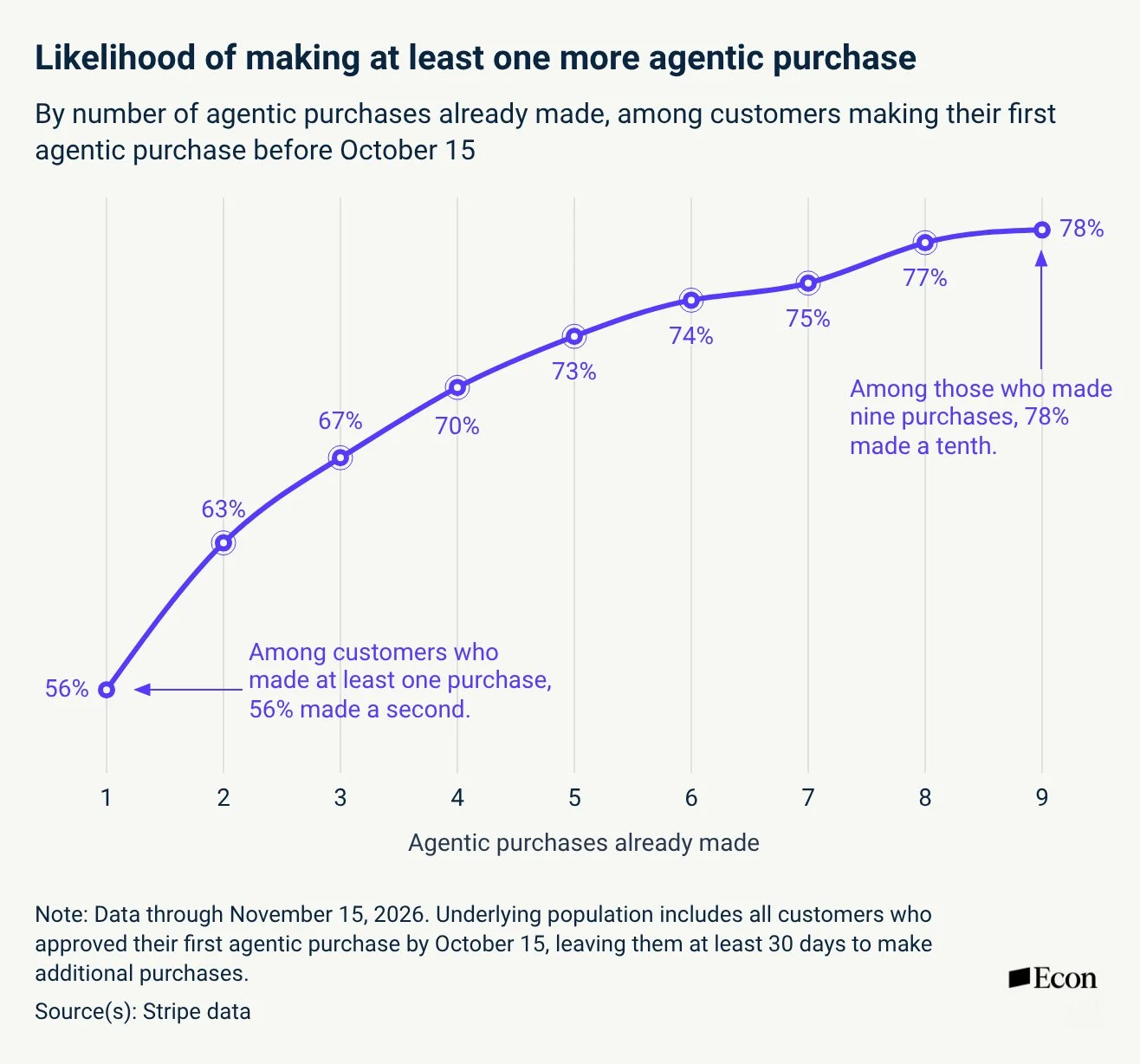
- Buyers come back: 56% of first-time agent buyers made a second purchase, and 78% of those with nine made a tenth. That's repeat use of agents, not necessarily of the same store.
- The agent picks the store first: from your product pages, your product data and what other sites say about you.
- Check five things before Black Friday: crawler access, product data, what AI says about your best sellers, bot rules on checkout, and how you'll measure agent visits.
What Stripe shared
Link is Stripe's consumer wallet. In 2026 Stripe opened it to agents: the person connects an agent to Link, approves each spending request, and the agent gets a one-time card or a Shared Payment Token backed by the person's saved card. The agent never sees the real card number. Here is what the November 20 update said, and what each number leaves open:
| What Stripe reported | What it doesn't tell you |
|---|---|
| 7,982% of the September 1 level (nearly 80×) in daily spend by November 19 (7-day average) | How much money that is. Growth this fast usually starts from a small base. |
| Spend doubled in the last month | Whether that's more people or bigger purchases. |
| 43% travel (airfare, travel, lodging), 34% retail, 7% life admin, 4% events, 11% other, in the week to November 19 | The size of a typical order. |
| 56% come back for a second agent purchase, typically in the same category | Whether they return to the same store. |
What agents buy in retail
Retail is the band that grows fastest in Stripe's chart through November. Here's how retail spending on Link's agent wallet split in the week of November 13–19:
| Retail category | Share of retail spend |
|---|---|
| Home furnishings, electronics and appliances | 22.9% |
| Specialty and miscellaneous retail | 17.2% |
| General merchandise | 17.2% |
| Clothing, shoes and jewelry | 13.7% |
| Wholesale supplies | 6.5% |
| Vehicles and parts | 5.9% |
| Groceries and beverages | 3.9% |
| Other or unclassified | 12.7% |
The top of the list is the kind of purchase people research before buying: a sofa, a TV, a washing machine. Those are the questions where an agent compares specs, prices and delivery across stores, which is exactly where clear product data wins.
People who buy through an agent keep doing it
Among people who made their first agent purchase before October 15, 56% made a second by November 15. Each purchase made the next one more likely: 63% of those with two made a third, and 78% of those with nine made a tenth.
Link is also one wallet among several. OpenAI launched ChatGPT Wallet the week before, for agents in ChatGPT, starting with Pro subscribers in the US, and card networks and banks are issuing agent credentials of their own. Stripe's numbers show the direction, not the size of the market. Stripe said it will share more around Black Friday and Cyber Monday; we'll update this post when it does.
Why it matters for a store: the agent chooses before it pays
When a person shops, they land on your site, look around, and maybe buy. When an agent shops, most of that happens out of sight. It searches the web, reads product pages and product data, weighs reviews and comparisons, and only then sends a payment to the store it picked. By the time a charge reaches your checkout, the choice is made.
So the questions for a store are the same ones as for AI search, with money attached:
- Can the agent read your pages? If a bot wall or robots.txt blocks it, your product isn't in the comparison.
- Does your product data answer the buyer's question? Size, material, compatibility, price per variant, stock, shipping time and returns, written as text, not only in images.
- Who else describes your product? If a marketplace or a reseller has a clearer page, the agent can buy your product there instead. We saw this before agents could pay: across 404 buyer questions for 27 small stores, most product links went to other sites.
The repeat-purchase numbers make the first sale matter more. If 56% of agent buyers come back, usually in the same category, the stores that show up well in November are the ones agents are likely to keep comparing in December and after.
Five things to check before Black Friday
1. Let AI crawlers and agents read your store
Check robots.txt and your bot protection (Cloudflare, your firewall, a Shopify app) for rules that block OAI-SearchBot, ChatGPT-User and other AI agents. Holiday "bot fight" settings are often turned up in November, exactly when agents need in. Here's how to allow OpenAI's crawlers.
2. Fill in your product data
Agents compare attributes. A product page that states the facts in text, and structured data that matches the live price and stock, is easier to choose than one that relies on photos. On Shopify, AI shopping agents also get your products from Shopify Catalog, which can add its own inferred features; see what ChatGPT is told about your Shopify products.
3. Ask AI about your best sellers
Take your top three products and ask ChatGPT and Google the questions shoppers are likely to ask before buying them: "best [product] for [use] under [price]", "[product] vs [competitor]". Look at whether you're mentioned, whether the price is right, and whether the link goes to your store or to someone else's. That's the shortlist an agent starts from.
4. Check that checkout doesn't stop an agent
The payment itself is a normal card or token payment. What can fail is the path to it: a CAPTCHA, a bot challenge on add-to-cart, or a fraud rule that declines a new card from an unfamiliar device. Look at your declined payments in November and make sure your rules aren't treating every automated visit as fraud.
5. Decide how you'll measure it
Agent purchases are hard to see in analytics. Visits from AI apps often arrive without a referrer and land in Direct in GA4 (why that happens), and an agent that reads a page leaves no session at all. Server-side logs show both: AI referrals and the agents fetching your pages (ChatGPT-User is the one that opens pages while answering someone). Set it up before the weekend so you have a baseline. More in how to track ChatGPT referral traffic.
Is agentic commerce big yet?
Not in dollars, as far as anyone has published. But interest is rising fast. In the US, Google searches for "agentic payments" went from 590 in August 2026 to 1,300 in October, and "AI shopping agents" from 210 to 720. In AI assistants, "agentic commerce" was asked about 214 times in October against 36 a year earlier (DataForSEO estimates).
For most stores, agents will be a small share of this year's holiday sales. The reason to check now is that the work is the same work that gets you into AI answers: readable pages, complete product data, and a clear reason to pick you. It pays off either way.
See what AI tells shoppers about your products
Our free check asks ChatGPT and Google questions your customers are likely to ask and shows whether you're mentioned, which pages are cited, and who is named instead.
Frequently asked questions
What is agentic commerce?
Shopping where an AI agent searches, compares and buys for the person, usually with their approval, paying with a one-time credential instead of their real card number.
How much are AI agents spending?
No one has published totals. Stripe reported nearly 80-fold growth on Link's agent wallet from September to mid-November 2026, and a doubling in the last month.
What do AI agents buy?
On Link in mid-November 2026: 43% travel, 34% retail. Within retail, home furnishings, electronics and appliances lead at 22.9%.
Do I need to change my checkout?
Usually not for the payment. Check bot protection, CAPTCHAs and fraud rules, which can stop an agent before it pays.
How does an agent choose a store?
From what it can read: your product pages and data, and what reviews, comparisons and marketplaces say about your products.
Be on the agent's shortlist
SearchMention asks ChatGPT and Google questions your customers are likely to ask and shows, per product, whether you're mentioned, whether the price is right, and where AI sends buyers instead.