Why ChatGPT Traffic Shows as Direct in GA4 (2026)
One URL on our own site told the story clearly: first-party AI tracking counted 101 referrals, GA4 recorded 88 Views — and most of those sessions were labeled Direct. Attribution failed. The visits did not.
Is ChatGPT sending you traffic you can't see?
SearchMention separates human AI referrals from live fetches and training crawlers — so you stop guessing what GA labels as Direct.
Explore AI TrafficTwo weeks ago we published site-level numbers: AI assistants sent us far more visits than Google organic in the same window. The follow-up question from our own team was sharper — if SearchMention shows AI referrals to a URL, should Google Analytics show the same page being opened?
Not “should GA credit ChatGPT.” Just: should Views go up?
We picked the URL that was eating most of our AI referrals — /blog/best-ai-search-optimization-tools — and lined up three tools for roughly the same 28 days: our own AI Traffic log, GA4, and Google Search Console.
TL;DR
- 101 first-party AI referrals to one blog URL ≈ 88 GA4 Views on the same path.
- GA explicitly labeled only ~6 sessions as
chatgpt.com; ~78 sat in (direct) / (none). - GSC showed 1,014 impressions and 0 clicks — Google was not the channel.
- “Direct” here means missing attribution, not fake traffic.
- Cross-check path Views in GA against AI referral counts. Do not expect Session source to match.
What “attribution” means (in one sentence)
Attribution is the label GA puts on a visit — Direct, Organic, Referral, and so on. A visit can be 100% real and still get the wrong label if the Referer header or campaign parameters never arrive. That is what happened to most of our ChatGPT landings.
The case study URL, three ways
Window: roughly late July through mid-August 2026 (~28 days). Same path everywhere.
| Source | What it measures | Result |
|---|---|---|
| SearchMention AI Traffic | Human visits with AI Referer or known utm_source |
101 referrals |
| GA4 — pagePath Views | Client-side pageviews where gtag ran | 88 Views |
| GA4 — session source | How GA named those sessions | ~78 Direct · ~6 chatgpt.com |
| Google Search Console | Google Search only | 1,014 impr · 0 clicks |
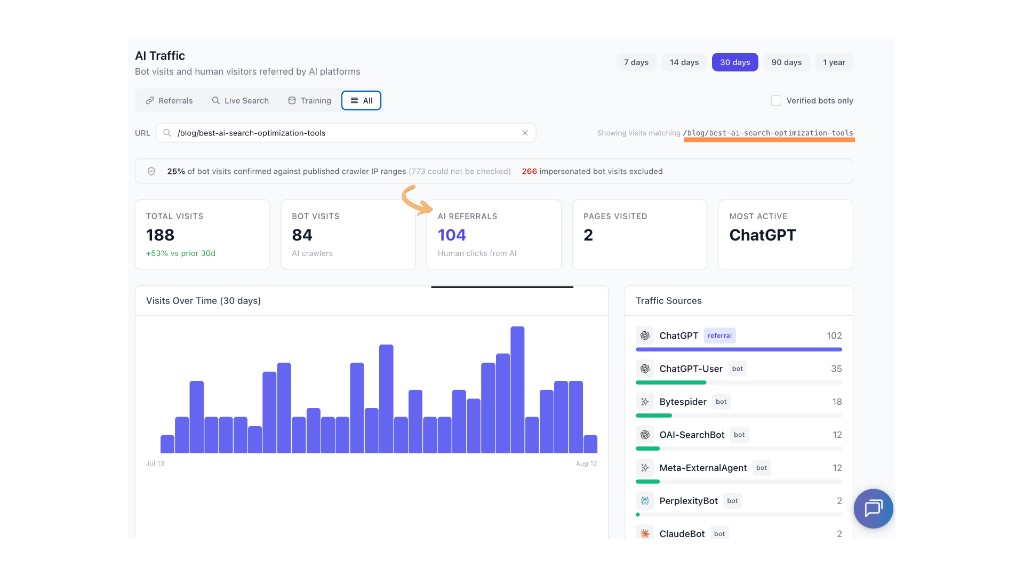
The important comparison is row 1 vs row 2: 101 ≈ 88. That is close enough to trust that people actually opened the page. The misleading comparison is row 1 vs “chatgpt.com” in GA — that filter only catches the minority of sessions where attribution survived.
Engagement on those landings was thin (roughly 18–22% engaged sessions, high bounce). That is a conversion problem, not a data-integrity problem. The traffic arrived; it did not stick.
Why GA buries ChatGPT in Direct
GA4 can only attribute what the browser reports. ChatGPT traffic arrives in a few messy patterns:
- Clean referral — desktop web click with
Referer: https://chatgpt.com/. GA showschatgpt.com / referral(or a custom AI channel if you built one). - UTM-only — ChatGPT Search / citation links often append
utm_source=chatgpt.com. The UTM can survive even when Referer is stripped. Without a medium, some of these land in Unassigned rather than Referral. - Stripped signal — mobile apps, sandboxed browsers, and
noreferrerlinks send neither Referer nor UTM. GA has nothing left → (direct) / (none).
On our path, page referrer in GA was almost entirely “(not set)” while Views still stacked up. That is exactly the stripped-signal pattern. First-party tracking at the edge still saw the AI Referer or UTM on the inbound request — before the browser finished deciding what to tell gtag.
So when someone says “we have no ChatGPT traffic in GA,” ask a better question: do Views on the cited URLs move, and does first-party AI referral tracking agree?
What GSC adds (and what it cannot)
Search Console answered a different question cleanly: Google was showing the page (1,014 impressions at an average position around 75) and nobody was clicking. The queries were on-topic — “ai optimization tools,” “ai search optimization platform,” and cousins — but deep rankings produced zero organic visits.
That is useful context. It means the 88 GA Views were not secretly Google organic mislabeled as Direct. GSC closed that loophole. For how Google demand looks when AI is already sending people, see also our site-wide AI vs Google comparison.
Referrals vs live fetch vs training
AI Traffic is not one number. On the same URL we also saw a handful of live-search fetches (verified ChatGPT-User) and almost no meaningful training-crawler volume. Those are different stories:
| Signal | Means | Business weight |
|---|---|---|
| Referrals | A human clicked from an AI surface | Highest — someone landed |
| Live Search fetch | An assistant retrieved the page to answer | Supporting — you are in the retrieval path |
| Training crawl | A bot ingested the page for models | Background — not a shopper |
GA filters most of the bot rows by default. GSC never sees them. If you only watch those two tools, you miss the crawl/fetch side entirely — and you misread the human side whenever attribution breaks. For the broader citation-tracking playbook across engines, start with how to track AI search citations.
How to check your own URLs (30 minutes)
- Pick a URL you believe AI cites — a product page, a comparison post, or anything showing up in ChatGPT answers when you test buyer prompts.
- In GA4, open Explorations → free form. Dimension: Page path and screen class (or Landing page). Metric: Views + Sessions. Filter to that path for 28 days. Ignore source for this pass.
-
Second GA pass: Session source / medium for the same path. Note how much is Direct vs
chatgpt.com/openai/perplexity.ai. - In GSC, filter Performance by that page. If impressions are high and clicks are near zero, Google is not explaining your Views.
- Add a first-party AI referral view — server logs filtered on AI hostnames, a Cloudflare Worker, or AI Traffic analytics. Compare referral count to GA Views on the same path. Same ballpark → trust the landings. Huge gap with GA near zero → consent/tag/blocker issues. Huge gap with GA high but AI referrals low → you may be counting crawlers as humans (or the reverse).
Optional but useful: build a custom GA4 channel group for AI hostnames so the attributable slice is easier to find. Just remember it only reclassifies sessions that still carry a source signal — Direct stays Direct forever.
What this is not claiming
- We are not saying every site will see 101 AI referrals on a blog post. Our niche is AI-heavy and the absolute numbers are still small.
- We are not saying GA is “wrong” about Direct. Given the headers it received, Direct was the honest label.
- We are not saying first-party referral counts equal engaged shoppers. Ours bounced hard — that is the next problem to solve.
- Windows are aligned approximately, not to the second. Treat the ratio as directional.
The claim is narrower: if you only trust Session source in GA4, you will systematically undercount ChatGPT. Path-level Views plus first-party AI referral tracking fix most of the blindness.
FAQ
Why does ChatGPT traffic show as Direct in GA4?
Many ChatGPT surfaces strip or never send a Referer — especially mobile apps. Without Referer or a surviving utm_source, GA4 defaults to (direct) / (none). The pageview can still fire; only the source label is missing.
If GA says Direct, was the ChatGPT visit fake?
No. On our case-study URL, first-party AI referrals (101) lined up with GA Views (88). Explicit chatgpt.com in GA was only a small slice. Direct meant unlabeled, not invented.
Can Search Console show ChatGPT referrals?
No. GSC is Google Search only. Our URL had 1,014 impressions and 0 clicks while AI assistants were driving the Views GA filed under Direct.
How do I measure ChatGPT traffic GA under-attributes?
Capture Referer / known AI UTMs at the edge or in first-party analytics, then cross-check GA Views for the same path. Matching volume is the trust check; matching Session source is not.
Referrals vs crawlers — what’s the difference?
Referrals are humans who clicked. Live-search bots fetch a page to answer a question. Training bots ingest content for models. Keep them in separate buckets or you will celebrate crawler hits as demand.
Next steps
- Run the five-step check above on your top product or content URL.
- Read ChatGPT traffic vs Google traffic for the site-level version of this story.
- If you sell online, use the Shopify AI search checklist so the pages AI fetches are actually cite-worthy.
- Compare platforms in best AI search optimization tools — the URL that produced these numbers.
See AI referrals without guessing Direct
SearchMention separates human AI referrals from live fetches and training crawlers — the split GA and GSC were never built to show.
Explore AI Traffic