What ChatGPT Is Told About Your Shopify Products: Inside Shopify Catalog (2026)
We looked up every product of one Shopify store in Shopify Catalog. Four were left out, and one bundle goes to AI agents with features the store never wrote.
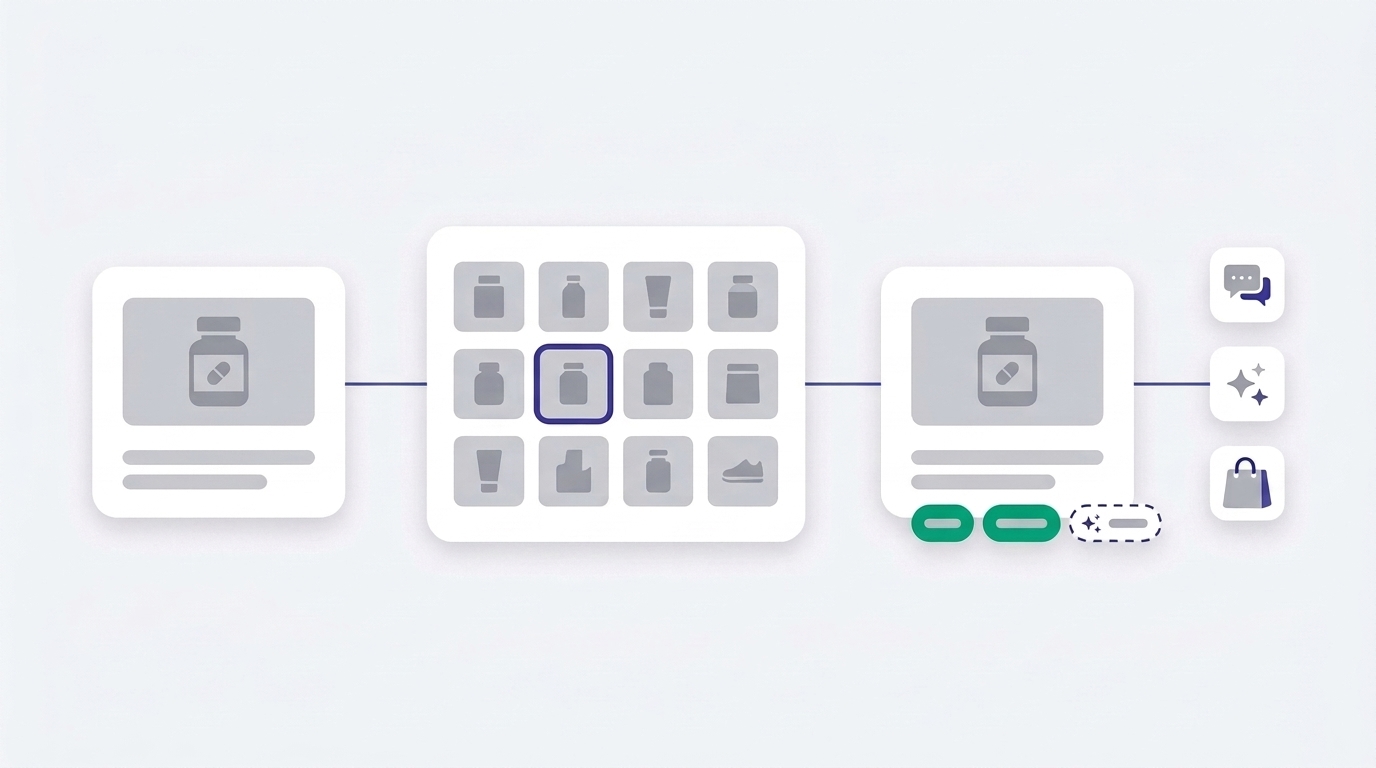
Start with the basics agents rank on
The free AI readiness scan checks crawler access, the storefront password, Product markup and, on Shopify, whether your products have real descriptions, images and a category, and whether your refund and shipping policies are published.
Scan My Site FreeHow does ChatGPT get product data from Shopify? Through Shopify Catalog, Shopify's structured index of eligible products from Shopify stores: OpenAI says Shopify merchants' product data "is already integrated into ChatGPT through Shopify Catalog," with no work required from the merchant. Why isn't my product in it? Usually because the store is password-protected or still building account standing, or the product has no image, a $0 price, Unlisted status, or falls in a category Shopify excludes, such as CBD supplements or add-ons like shipping protection (Shopify's requirements).
Being in the catalog is the start, not the finish. The catalog also decides what agents are told about each product, and part of that is written by Shopify, not by you. To see it concretely, we looked up all 86 products of a US supplement store through Shopify's Catalog API on October 11, 2026, and checked what came back against the store's own pages. We call the store Pellwick Nutrition here: store names in this post are changed, the numbers are real.
TL;DR
- Shopify Catalog feeds ChatGPT, Copilot and the Shop app. Eligible products are included automatically; you can't opt out of the catalog itself.
- Products go missing for store reasons (password, plan, account standing) and product reasons (no image, $0 price, Unlisted, excluded category by Shopify's own classification). Out-of-stock items drop out of searches by default.
- Agents receive more than you wrote: Shopify may generate or enrich the description and infers top features, selling points and specs that it says "might vary in accuracy."
- In our test: 82 of 86 products were in; a turmeric bundle went out with a one-line description, no category, and inferred "Free from common allergens."
- Catalog rank isn't ChatGPT's answer: the store was #1 of 329 in the catalog for a magnesium question that ChatGPT answered without naming it. For a supplement store there's a likely reason: OpenAI keeps supplements out of ChatGPT's product results.
- Check yours in Sales channels → Agentic (search preview), or paste a product URL into our free Shopify Catalog checker.
What Shopify Catalog is
Shopify describes Shopify Catalog as "a structured source of product information gathered from eligible products that are sold by stores on Shopify." Shop, select AI platforms, shopping sites and AI agents use it to search and understand titles, descriptions, images, prices, options and availability. If your store and products meet the requirements, they're in automatically. You can stop individual AI channels from accessing it in your admin, but "you can't opt out of Shopify Catalog itself."
Who reads it: Shopify's Spring '26 developer edition says "ChatGPT, Copilot, and the Shop App are the most visible surfaces today," and that any developer can now query the catalog with an API key, no approval needed. That last part matters: the catalog isn't only read by the big assistants, and you can read it too.
What it doesn't do: decide the answer. Shopify says inclusion "doesn't guarantee that a product will appear in a specific AI answer, be ranked in a specific position, or be displayed by every channel," and that "each channel controls the final ranking, wording, and shopping experience." ChatGPT also reads the open web through its own crawler, so your product pages still matter (see how to allow OpenAI's crawlers). And it isn't the llms.txt file apps offer to publish; Shopify already serves that one for you.
Why products are missing from Shopify Catalog
Shopify's requirements page lists three layers. If a product is missing, walk them in this order:
| Layer | What leaves products out |
|---|---|
| Store | Below the Starter plan; private mode (storefront password); not complying with Shopify's Terms or Acceptable Use Policy |
| Account standing | Unverified email or business, no two-step login, little sales history, slow fulfillment, high chargebacks, late invoices, open policy issues. "Reviewed over time," so a new store can be missing entirely |
| Product | No title or no image; price of zero; not published to the Online Store, Hydrogen or Headless channel; no product URL; Unlisted or hidden from search engines; sensitive content |
| Category | Alcohol, tobacco and vaping, CBD supplements, prescription and medical products, weapons, services and add-ons (extended warranties, installation, insurance), event tickets, live animals, "Uncategorized" and more |
Two details catch merchants out. First, the excluded category is decided by Shopify's own classification of your product information, which "can differ from the product category that you set in your Shopify admin." A vague title and an empty description can land a real product in "Uncategorized." Second, availability: in the Catalog API, the available filter defaults to true, so out-of-stock items don't come back in a normal search even though they're still in the catalog.
Here's how that played out for Pellwick Nutrition. We looked up all 86 products on its storefront by URL:
- 82 were in the catalog and returned normally.
- 2 were hidden because they were out of stock: a tote bag and a leftover test product. Both came back only when we searched with
available: false. - 2 were not in the catalog at all: "Shipping Protection," an add-on (excluded category), and "Build Your Own Bundle," which is listed at $0.00 on the storefront because the price comes from what the shopper picks (free products are excluded).
None of the four is a loss here. But the same rules would quietly drop a real product priced at $0 for a bundle builder, or a supplement Shopify's classifier reads as CBD.
What agents receive about each product
Shopify's Global Catalog docs list what a lookup or search returns. For each product: title, price range, images with alt text, variants with price and availability, a category, and a rating from verified review sources. Per variant, a field called eligible.native_checkout says whether the product can be bought inside the AI chat rather than on your site.
Then there are fields Shopify marks Inferred: a description "generated or enriched by Shopify," plus top_features, unique_selling_points, tech_specs and attributes. Shopify's own wording: these "might not always be present or might vary in accuracy depending on available product data. Treat them as discovery and merchandising signals, not as merchant-authored source text." In other words, an AI assistant reading your product through the catalog may be reading Shopify's summary of it.
A thin product: the turmeric bundle
Pellwick's "Turmeric Curcumin- 3 Bundles" ($59.99) has a product description that just repeats its title. This is what the catalog sent back:
| Field | What agents receive |
|---|---|
| Description | "Turmeric Curcumin- 3 Bundles" (the store's one line, as is) |
| Category | None |
| Rating | None |
| Top features (inferred) | "Contains both turmeric and curcumin for synergistic health support" · "Non-GMO ingredients for a cleaner supplement option" · "Oral capsule form for easy daily intake" · "Free from common allergens for broad dietary compatibility" |
| Tech specs (inferred) | Form: Capsules · Bundle Size: 3 bundles · Key Ingredient: Curcumin · Dietary Preference: Non-GMO · Route: Oral |
| Buy in chat | No (native_checkout: false) |
None of those features is on the bundle's page. Some may still be true: the store's single-bottle turmeric page does mention non-GMO. But "free from common allergens" appears nowhere in the store's product copy, and it's the kind of claim a shopper with an allergy acts on. "Contains both turmeric and curcumin" is also an odd way to describe a product whose active compound is curcumin from turmeric. When the source text is one line, the inference has little to work from.
A well-described product: the magnesium
Compare the store's main magnesium product (90 capsules, $27.99). Its description is a real paragraph with four bullet points, and the catalog passed it through unchanged. The inferred features stayed close to what the store wrote ("Third-party and triple lab tested for quality assurance," "Made in California to the highest standards"), and the record carries a 5.0 rating from 1,582 verified reviews. The difference between the two records is the input.
Neither record had a category. On Shopify, that's the standard product taxonomy field in the product editor, separate from the free-text product type, and it's one of the things Shopify asks for in its guide to optimizing products for AI platforms.
Catalog rank isn't the same as ChatGPT's answer
We asked the catalog the same six buyer questions we had asked ChatGPT and Google AI Overviews for this store, in the US. For "best third-party tested magnesium brands," Pellwick's magnesium was #1 of 329 matching products in Shopify Catalog (#1 of 325 on a re-check later the same day). ChatGPT's answer to that question didn't name the store; Google's AI Overview did. On the other five questions the store ranked #46 and #50 in the catalog or outside the top 50, and ChatGPT named it in none of the six. A merchant on Shopify's developer forum reported the same gap at a larger scale: #4 of 20 in a Global Catalog search for a motorcycle tire, product resolved by lookup, yet missing from ChatGPT Shopping since July 25, with Shopify support and OpenAI support each pointing to the other. The catalog is the input; ChatGPT still picks. You need to look at both.
For this store there's a likely reason behind the gap. Shopify's ChatGPT page says products on OpenAI's prohibited list don't show in ChatGPT's product discovery results, even when they're in Shopify Catalog, and OpenAI's commerce policy lists supplements, including ingestible products marketed for health effects. So a supplement's #1 catalog rank can't turn into a ChatGPT product card. ChatGPT can still name the brand in an answer, from pages it finds on the web. If you sell supplements, CBD or medicines, judge ChatGPT by those answers rather than by its shopping results; Copilot and the Shop app still read your catalog.
How to check it yourself
1. The search preview in your admin (free, no code)
In Shopify admin, open Sales channels → Agentic. The search preview runs a query against Shopify Catalog and shows the raw results, whether any of your products are in the global top 10, and a preview of how each AI channel might display them. It also lists "Top search queries" and "Queries where your products appeared," and a listing-quality meter per product: description completeness, image count, verified reviews, variant completeness and store policies. If none of your products rank, it shows your most relevant ones with an "Improve your listing" section.
What it doesn't show: the inferred features, ranks beyond the top 10, or what ChatGPT actually answered.
2. The Catalog API or UCP CLI (for the full record)
To see exactly what agents receive, look a product up. Shopify's Spring '26 notes say the lookup endpoint "resolves a list of product URLs into real Catalog matches," so you can paste your own product URLs. Our free Shopify Catalog checker runs that lookup for one product URL, with no setup. The docs show the calls through the UCP CLI, for example:
ucp catalog search \
  --set /query='best third-party tested magnesium brands' \
  --set /context/address_country=US
In the response, read the description, metadata.top_features, unique_selling_points and tech_specs of your products, and compare them line by line with your product page. Anything you didn't write and can't stand behind is a reason to improve the source text.
What to fix
- Rewrite one-line descriptions first. The thinner the description, the more the catalog has to infer. State ingredients, dose, form, certifications and what the product is free from, in your own words.
- Set the standard product category in the product editor, not just the product type. It also helps Shopify's classifier keep the product out of an excluded bucket.
- Give bundles and builders a real price. A $0 listing is excluded; list the bundle at its starting price if you can.
- Keep stock and variants accurate. Out-of-stock items drop out of searches, and variant completeness is one of Shopify's listing-quality signals.
- Publish refund and shipping policies, and collect reviews through an app whose reviews Shopify counts as verified.
- Then check the answers, not just the catalog. Ask ChatGPT and Google the questions your buyers ask and see whether your products are named, linked and priced correctly. Our post on why products don't show up in ChatGPT covers the web side, and why ChatGPT links another store covers the link side.
For everything else on the store side, our Shopify AI search checklist goes step by step.
Frequently asked questions
How does ChatGPT get product data from Shopify?
Through Shopify Catalog. OpenAI says Shopify product data is already integrated into ChatGPT that way, with no work from the merchant. Copilot and the Shop app use it too; each decides its own ranking and wording.
Why isn't my Shopify product in Shopify Catalog?
Check the store (password, plan, account standing), then the product (image, price above $0, published, not Unlisted), then the category Shopify assigns (CBD, add-ons, alcohol and others are excluded). Out-of-stock products are hidden from searches by default.
What does Shopify Catalog tell agents about a product?
Title, price, images, variants, availability, category, rating and in-chat checkout eligibility, plus a description and features that Shopify may generate. Shopify says the inferred fields might vary in accuracy.
How can I check what it shows for my products?
Sales channels → Agentic in your admin has a search preview (top 10, listing quality). For the full record, look up your product URLs through the Catalog API or UCP CLI.
If I rank #1 in the catalog, will ChatGPT recommend me?
Not necessarily. We saw a #1 of 329 that ChatGPT didn't name (a supplement, which OpenAI's commerce policy keeps out of ChatGPT's product results), and a forum merchant ranked #4 yet was missing from ChatGPT Shopping for a month.
See what AI actually answered
SearchMention asks ChatGPT and Google the questions your shoppers ask and shows, per product, whether AI named it, who it named instead, the price it quoted against your live variants, and where it sent the buyer.
See how AI Visibility works