How to Track ChatGPT Referral Traffic to Your Store (2026)
GA4 often labels ChatGPT clicks as Direct — or misses them entirely. Here are four methods that actually work, including first-party numbers from our own store.
See ChatGPT referrals without GA4 noise
SearchMention AI Traffic logs human referrals and AI bot crawls at the edge — so chatgpt.com clicks don’t disappear into Direct.
Explore AI TrafficIf you ask ChatGPT how to track referral traffic from ChatGPT to your store, it usually says: add UTM parameters, open GA4, and look at Acquisition. That advice is incomplete for e-commerce in 2026.
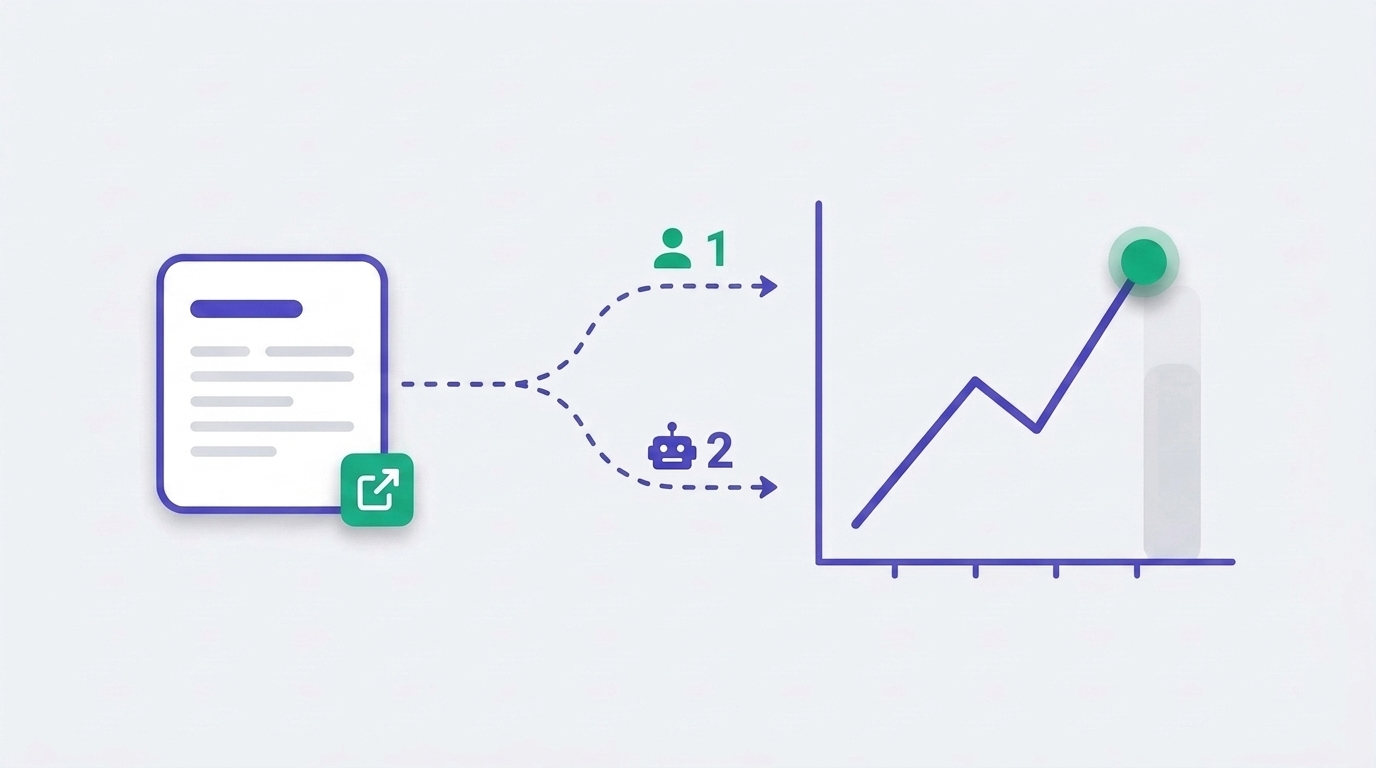
When ChatGPT cites your product URL, the link almost never carries your UTMs. Many ChatGPT surfaces strip or never send a Referer header. GA4 then parks the session in Direct — or a blocked analytics script never records the hit at all. We measured this on our own site: first-party logging counted 120 human AI referrals to one blog URL in 28 days; GA4 recorded about 55 Views for the same path. Same visitors, roughly half invisible in Google’s report.
This guide is the practical playbook for the question “How do I track AI referral traffic from ChatGPT to my store?” — separate human clicks from bot crawls, stop trusting Direct as “no AI,” and pick a method that matches your stack.
TL;DR — four methods
- Method 1 — GA4 (limited). Free. Catches some chatgpt.com / perplexity.ai referrals. Misses stripped-referrer clicks and most bot crawls.
- Method 2 — Server or CDN logs. Free–cheap. See GPTBot / OAI-SearchBot fetches. Does not prove a human clicked.
- Method 3 — First-party edge tracking. Cloudflare Worker (or similar) logs referrer host + bot UA before ad blockers. Separates referrals from crawls.
- Method 4 — AI Traffic product. Same edge idea, with a dashboard. What we built for SearchMention — see AI Traffic.
Two signals people mix up
Before picking tools, split the problem:
| Signal | What it means | Why it matters |
|---|---|---|
| AI referral (human) | Someone clicked from an AI answer to your store | Revenue, sessions, conversion |
| AI bot crawl | GPTBot, OAI-SearchBot, PerplexityBot fetched a URL | Discoverability / eligibility to be cited |
A page can be crawled heavily and still send zero human referrals — or the reverse. Track them in separate buckets or you will optimize for the wrong failure.
Method 1 — Google Analytics 4 (what it can and can’t do)
Keep GA4. Just don’t treat it as the system of record for ChatGPT.
What works:
- Filter Acquisition → Traffic acquisition for source/medium containing
chatgpt,openai,perplexity,gemini. - Use UTMs on links you control (email, ads, in-product help that an AI might copy).
- Compare landing-page Views to your first-party counts when you have them.
What fails:
- Organic citations without UTMs → often Direct. Full write-up: Why ChatGPT traffic shows as Direct in GA4.
- Ad blockers and ITP kill the GA tag more often than a first-party edge pixel.
- Default bot filtering hides GPTBot-style crawls you may want for readiness.
- GSC never shows AI referrals — only Google Search. Our case-study URL had 1,014 GSC impressions and 0 clicks while AI was sending the traffic GA called Direct.
Use GA4 as a lower bound, not as proof that “ChatGPT isn’t sending traffic.”
Method 2 — CDN / server logs for AI bots
If you only need “did ChatGPT’s crawlers read my product pages?”, logs are enough:
- Cloudflare / Fastly / nginx access logs filtered for
GPTBot,OAI-SearchBot,ChatGPT-User,PerplexityBot,Google-Extended. - Verify reverse DNS where you can — spoofed UAs are common.
- Watch
robots.txtmistakes (especially Shopifyrobots.txt.liquid) that block shopping crawlers.
This method does not answer “how many humans clicked.” Pair it with Method 3 or 4 for referrals.
Method 3 — First-party edge tracking (the reliable referral path)
Log the request at your CDN edge before the HTML loads analytics:
- Capture path, timestamp, user-agent, and
Referer/sec-ch-uawhere present. - Classify referral vs bot with known AI hostnames and bot patterns.
- Store rows in your own DB (or a Worker KV / queue → API).
- Build a simple timeline: referrals by platform, top paths, verified bot crawls.
We open-sourced the pattern as a Cloudflare Worker that POSTs to SearchMention’s ingest API — setup guide: Cloudflare Worker manual. Shopify and Magento merchants can use platform-native collectors instead of CF.
Why this beats GA for AI: first-party host, no third-party cookie dependency, explicit bot vs human split, and you keep the raw referrer string even when GA would have said Direct.
Method 4 — Use an AI Traffic product
If you don’t want to maintain Workers and classifiers, use a product that already does Method 3. On SearchMention, AI Traffic shows:
- Human referrals by platform (ChatGPT, Gemini, Perplexity, Claude, …)
- Bot crawls with verification status
- Per-path filters (e.g. only
/products/…) - Export via API for your own warehouse
On searchmention.com over a recent 28-day window we counted ~250 AI referrals sitewide (~95% ChatGPT). That is the channel we optimize for — not GSC clicks (still near zero on the same cluster).
Related: volume comparison in ChatGPT sent us 199 visitors; Google sent 9.
A 30-minute setup checklist
- Confirm AI crawlers are allowed in
robots.txt(readiness scan helps). - Deploy edge logging (Worker or platform collector).
- Tag only the links you control with UTMs — don’t expect organic ChatGPT citations to carry them.
- In GA4, create a comparison exploration for AI sources — treat it as a floor.
- Weekly: export referrals by path; note which URLs get clicks vs only crawls.
- If a URL is crawled but never referred, fix the answer on the page (citations), not just ads.
What “good” looks like
There is no public industry benchmark yet. Use your own baseline:
- Referrals / 28d by platform (ChatGPT should dominate for most stores today).
- Concentration — if one URL is >40% of AI referrals, you have a concentration risk (we did: one listicle carried nearly half).
- GA gap — first-party ÷ GA Views on the same path. A gap near 2× is what we see when blockers + Direct collide.
- Crawl → referral lag — days from first verified bot hit to first human referral on that path.
Frequently asked questions
How do I track AI referral traffic from ChatGPT to my store?
Log human clicks (referrer / platform) separately from AI bot crawls. Don’t rely on GA4 alone — use edge first-party tracking or an AI Traffic product, and treat GA as a lower bound.
Will UTMs fix attribution?
Only for links you tag. Organic citations from ChatGPT usually have no UTMs and often no usable Referer.
Does Direct mean the traffic isn’t from ChatGPT?
No. Direct means GA couldn’t name a source. See our Direct attribution case study.
Should I block GPTBot to reduce “bot traffic”?
Usually no — blocking shopping / search crawlers can remove you from answers. Measure bots; don’t confuse them with human referrals.
Next steps
- Stand up edge logging or AI Traffic so ChatGPT clicks stop vanishing into Direct.
- Read why GA4 labels ChatGPT as Direct if you need the attribution deep dive.
- Track whether AI cites your products at all with AI Visibility — traffic without citations is a different problem.