ChatGPT Business Hub vs AI Visibility Tools: What Each One Shows (2026)
Business Hub has the real numbers. A visibility tool has the reasons behind them. We make one of those tools, so here is where Business Hub beats it, and where it doesn't, yet.
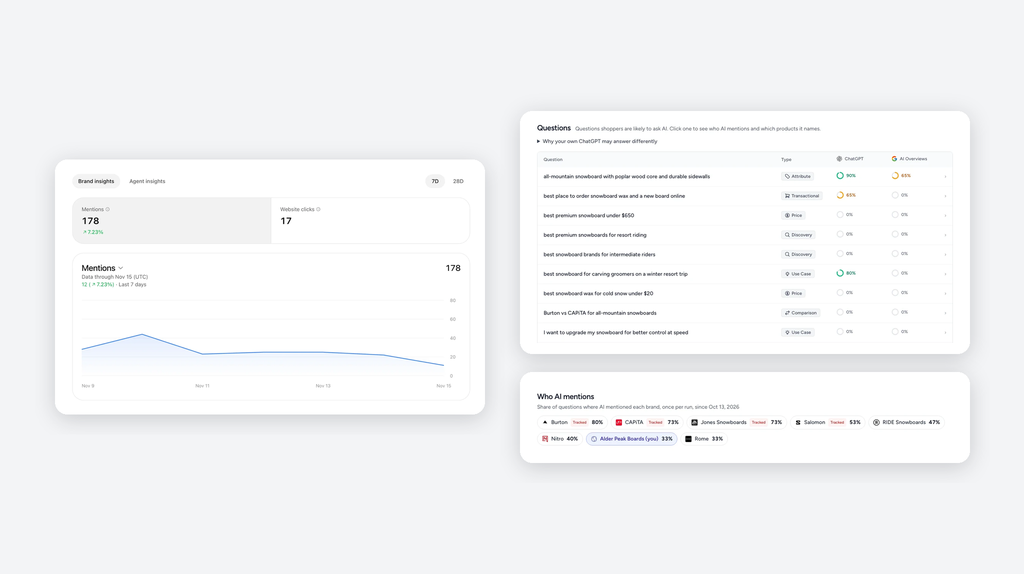
See the questions behind your mentions
Our free check asks ChatGPT and Google questions your customers are likely to ask and shows whether you're mentioned, which pages are cited, and who is named instead.
Do you still need an AI visibility tool now that ChatGPT has Business Hub? For counting, no tool can match Business Hub: its mentions and clicks come from real ChatGPT conversations, not from a sample of questions someone picked. For deciding what to change, you still need one. Business Hub doesn't show the questions, the answers, the other pages ChatGPT cited, the competitors it named instead of you, or anything outside ChatGPT. Use Business Hub as the scoreboard and a visibility tool to find out why the score moves.
OpenAI opened Business Hub on November 10, 2026. We claimed our own profile the same week (here's how to claim yours) and compared Business Hub's numbers with what SearchMention, our own tool, records for the same sites. The examples below come from FotoBookers, a photographer booking site that uses SearchMention to track its AI visibility, and a snowboard shop tracked in SearchMention.
TL;DR
- Business Hub wins on volume and truth: FotoBookers had 178 real mentions and 17 clicks in one week. A tool asking 20 questions twice a week sees 40 answers.
- Its clicks hold up: GA4 counted 15 ChatGPT sessions and our server logs about 14 visits over the same days.
- A tool shows the why: the questions and answers, every cited page, the competitors named instead, and what kind of sources win (for the snowboard shop: 61% store pages, 7% YouTube, 7% forums).
- A tool sees what Business Hub can't: mentions without a link, wrong prices, Google AI Overviews, Gemini, Perplexity, and AI crawlers (3,369 bot requests to FotoBookers that week).
- Use both: Business Hub's discovery topics tell you which questions to track; the tool tells you what to fix; your analytics tell you if it paid off.
Where Business Hub beats any AI visibility tool
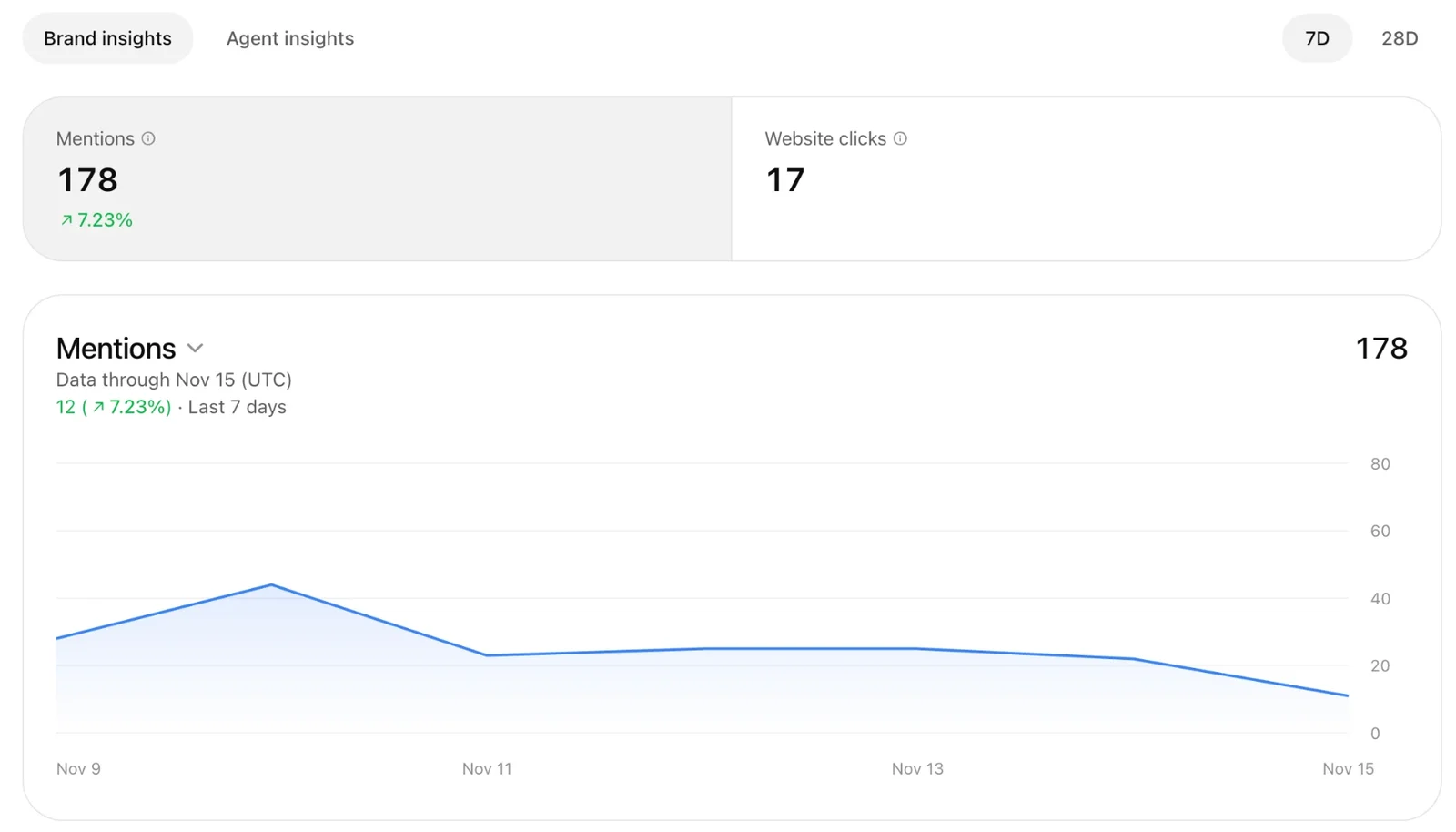
Business Hub gives you three numbers for the last 7 or 28 days: mentions (for an online business, ChatGPT answers that referenced your website), website clicks, and discovery topics (the themes of those answers). Here's FotoBookers for November 9–15:
Three things make these numbers better than anything a tool like ours produces:
- They're real conversations. A visibility tool asks questions you chose, from clean sessions, a few times a week. Its "mentioned in 33% of answers" is a share of that sample. Business Hub counts every answer that referenced you, across ChatGPT's 1.2 billion weekly users, including answers shaped by each person's history, location and memory, which no tool can reproduce.
- They include questions nobody thought to track. FotoBookers' 178 mentions in one week are more than four times the 40 answers a tracker gets from 20 questions asked twice a week on one engine.
- Clicks are measured, not estimated. A tool can tell you that you're cited. Only ChatGPT knows how many people clicked.
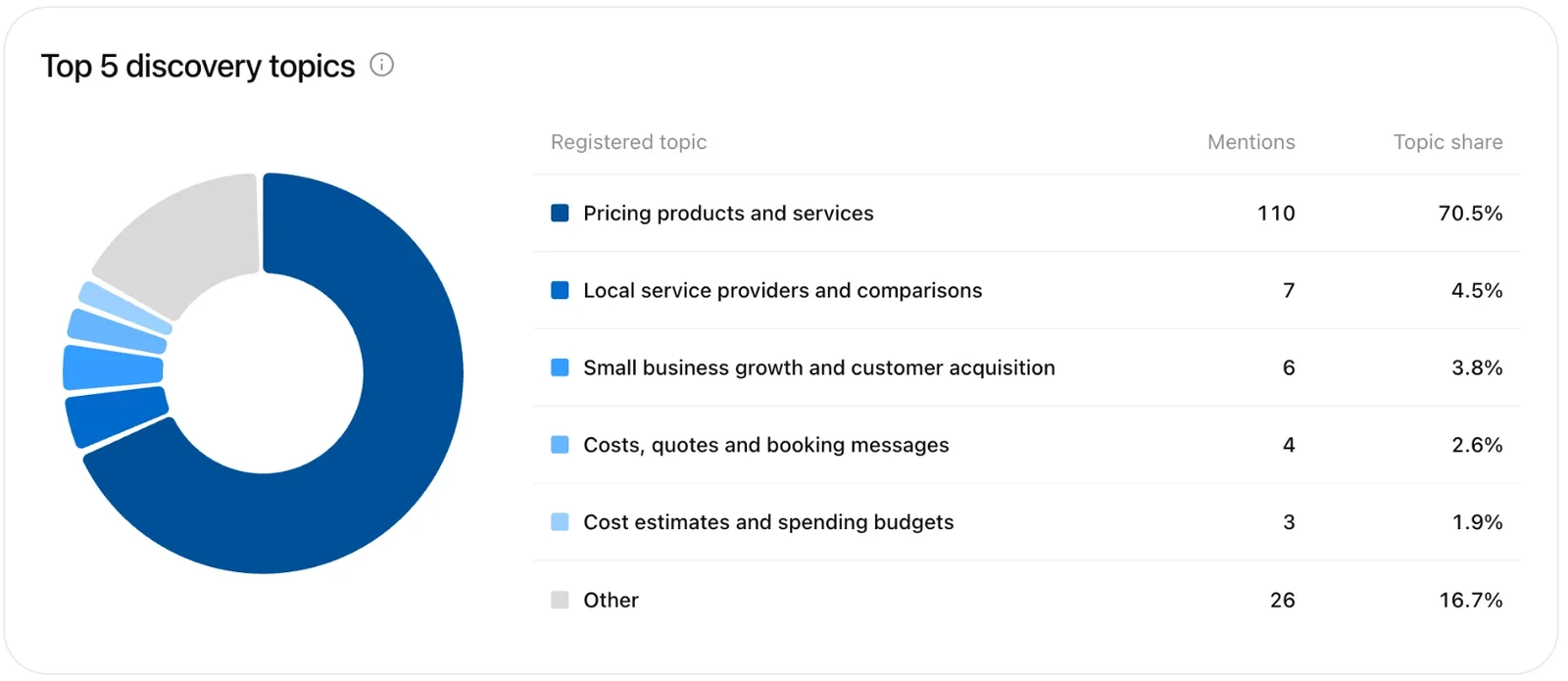
Discovery topics add something no tool has, too: what the demand is actually about. For FotoBookers, 70.5% of the answers that cited the site were about pricing products and services. You'd expect questions about finding a photographer.
And it's free. If your business is eligible, claim it.
Where an AI visibility tool still wins
Business Hub is aggregated by design: OpenAI doesn't share prompts or conversations with businesses, and numbers only appear above a reporting threshold. That leaves a lot it can't show. These are the gaps, with what we saw in each.
1. The questions and the answers
"Pricing products and services" is a topic, not a question. To act on it, you need to know which questions you're cited for, which ones you're missing from, and what ChatGPT actually said. A visibility tool keeps every answer to every tracked question, per engine:
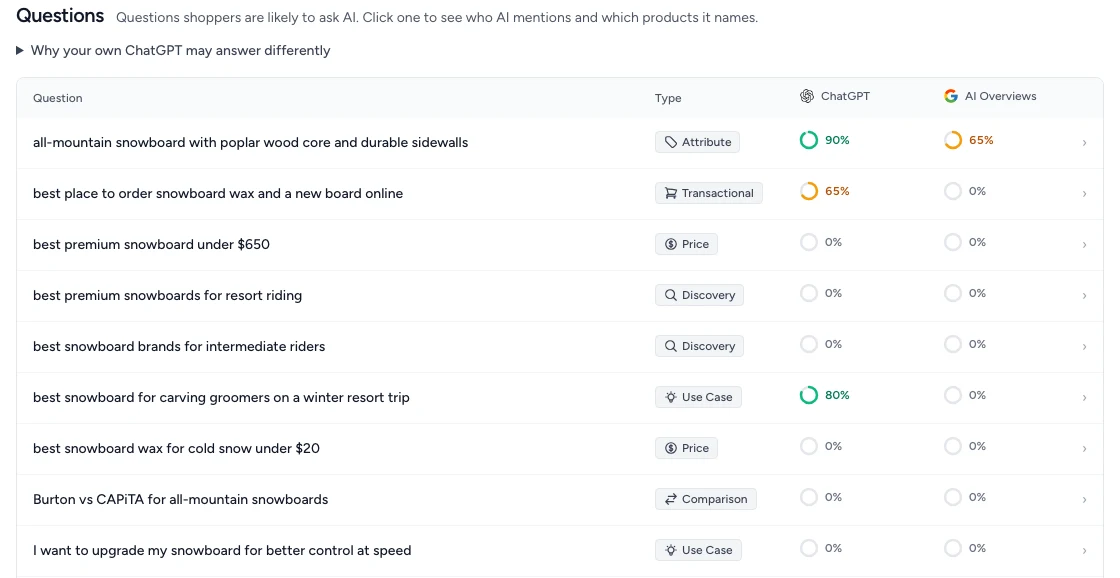
The snowboard shop wins "all-mountain snowboard with poplar wood core" on both engines and is absent from every price question. Business Hub would show it one mention count.
2. The citations that drive the mentions
A Business Hub mention means one of your pages was among the pages ChatGPT used. It doesn't tell you which page, or which other pages were next to it. Those other pages are the ones to study: they're what ChatGPT trusted for that question. For the snowboard shop's questions, the most cited sites were burton.com (19 citations), YouTube (17), evo.com (15), Facebook (14), jonessnowboards.com (12), capitasnowboarding.com (11) and Reddit (11).
3. The other brands and products AI names
Business Hub only knows about your business. A tool records every brand each answer names, including competitors you didn't know you were up against:

For online stores it goes down to products: which product AI recommended, and whether it sent the buyer to you, to a marketplace or to a reseller.
4. What kind of content gets cited
Knowing the type of each cited page tells you where to show up besides your own site. We classify every cited page. For the snowboard shop's 15 questions, the 232 citations broke down like this:
| Source type | Citations | Share | Most cited |
|---|---|---|---|
| Store and brand sites | 142 | 61% | burton.com, evo.com, jonessnowboards.com |
| Other | 28 | 12% | google.com |
| Forums | 17 | 7% | reddit.com, snowboardingforum.com |
| Video | 17 | 7% | youtube.com |
| Social media | 14 | 6% | facebook.com |
| Reviews | 11 | 5% | 6 review sites |
| Marketplaces and news | 3 | 1% | — |
For snowboards, a good YouTube review or a Reddit thread is worth about as much as a product page from a smaller shop. In another category the mix is different, which is the point of measuring it.
5. Mentions without a link, and what AI got wrong
Business Hub only counts an online business when the answer references its website. OpenAI's help article is explicit: "The brand name alone doesn't count." So an answer that names you without linking you isn't in your numbers, though the person still read your name. A tool records both, as mentioned (the answer names you) and cited (one of your pages is among its cited pages). It also keeps the text, so you can check what was said: for stores, we compare the price an answer quoted with the live price of that product variant.
6. Google AI Overviews, Gemini and Perplexity
Business Hub covers ChatGPT. Your customers also read Google's AI Overviews on a large share of searches, and use Gemini and Perplexity. The snowboard shop's questions show how different the engines can be: "best place to order snowboard wax and a new board online" named the shop in 65% of ChatGPT's answers and 0% of AI Overviews. SearchMention asks ChatGPT and Google AI Overviews on every plan, and Gemini and Perplexity on Growth and above.
7. The AI crawlers on your pages
Business Hub tells you "Website access: Access confirmed." That's all it says about crawling. FotoBookers' server logs for the same week show 3,369 requests from AI bots. OpenAI's three bots made 220 of them across 55 pages: OAI-SearchBot (which builds ChatGPT's search index) 125, ChatGPT-User (pages ChatGPT opens while answering someone) 65, and GPTBot (training) 30. Meta's crawler alone made 2,330. Knowing which pages the bots fetch, and which they never touch, is how you spot a page ChatGPT can't cite because it never reads it. More in how to allow OpenAI's crawlers.
8. A check of AI traffic against GA4
Business Hub's clicks are only useful if you can follow them to sign-ups and sales, and GA4 is bad at seeing them. Over the same seven days for FotoBookers:
| Source | ChatGPT traffic, Nov 9–15 |
|---|---|
| Business Hub | 17 website clicks |
| GA4 | 15 sessions from chatgpt.com |
| SearchMention AI Traffic (server side) | 25 page views, about 14 visits |
That week the three agree. Over longer periods they often don't: on searchmention.com over 90 days, GA4's "AI Assistant" channel counted about one in six of the AI-referred visits our server-side log recorded. Most visits from the ChatGPT app arrive without a referrer and land in Direct (why that happens). A server-side log also shows the landing page of each visit, which Business Hub doesn't.
9. Before you claim, below the threshold, and for other sites
Business Hub needs a claim, an ID check and enough activity to clear its reporting threshold; a new or small site sees dashes. It also only shows your own business. A tool works from the first day, for any site: a client before they've claimed anything, a prospect you're pitching, or the competitor who keeps winning. Agencies can share each report as a white-label link.
10. Same questions over time, so you can test a change
When Business Hub's mentions go up, you can't tell whether more people asked or ChatGPT liked you more. A tracker asks the same questions every run, so if you rewrite a page and its citations go up on the questions it targets, that's your change, not seasonal demand.
11. Turning the data into work
The data is only worth what you do with it. Because a tool keeps the answers and the pages that won them, it can draft the page you're missing from what actually got cited (SearchMention's content drafts are in beta). And with an API you can bring it into Claude or ChatGPT and ask in plain words: "which questions did we lose this month, and who won them?" Every SearchMention plan includes an account API token for that.
Side by side
| ChatGPT Business Hub | AI visibility tool | |
|---|---|---|
| Data source | Real ChatGPT conversations | Questions you choose, asked on a schedule |
| Volume and clicks | Yes, measured | No (a share of a sample) |
| Questions and answers | No (themes only) | Every one, kept |
| Other pages cited | No | Yes, with source type |
| Competitors named | No | Yes |
| Mentions without a link | Not counted | Counted |
| Engines | ChatGPT | ChatGPT, AI Overviews, Gemini, Perplexity |
| AI crawlers | "Access confirmed" | Every bot request, per page |
| Works for | Your claimed business, above a threshold | Any site, from day one |
| Price | Free | Paid (SearchMention from $29/month) |
How to use both
- Claim your business in Business Hub and keep its details current (step-by-step guide).
- Let discovery topics pick your questions. If 70% of your citations are about pricing, track pricing questions, not the ones you assumed.
- Track those questions on ChatGPT and Google, and read the answers you lose: who won, which pages they cited, what type of source.
- Fix or publish the page those answers point to, and watch its citations on the same questions.
- Check the outcome in Business Hub (mentions, clicks) and in your analytics (sign-ups, sales), not one or the other (how to track ChatGPT referral traffic).
Will Business Hub catch up? Probably in part. It's a beta, and a Search Console for ChatGPT is the obvious direction. But OpenAI has built it around not sharing prompts or conversations, and it will always be about ChatGPT and about you. The questions, the competitors and the other engines are likely to stay a tool's job.
Frequently asked questions
Do I still need an AI visibility tool now that ChatGPT has Business Hub?
For counting, Business Hub is better. For deciding what to change, yes: it doesn't show the questions, answers, other cited pages, competitors or other engines.
Why are Business Hub's numbers more accurate?
They count real conversations and real clicks, including questions nobody tracks. A tool's mention rate is a share of a sample of questions you chose.
What does a tool show that Business Hub doesn't?
Questions and answers, every cited page and its type, competitors and products named, mentions without a link, wrong prices, other AI engines, crawler visits, and a check against GA4.
Does Business Hub show which questions people asked?
No. You get grouped discovery topics above a reporting threshold, never prompts or conversations.
Can I check Business Hub's clicks against my analytics?
Yes. For one site in one week: 17 clicks in Business Hub, 15 sessions in GA4, about 14 visits in server logs. GA4 often counts fewer because ChatGPT app visits land in Direct.
Find out why your mentions move
SearchMention asks ChatGPT and Google questions your customers are likely to ask and shows, per question, whether you're mentioned, which pages are cited, and who's named instead.