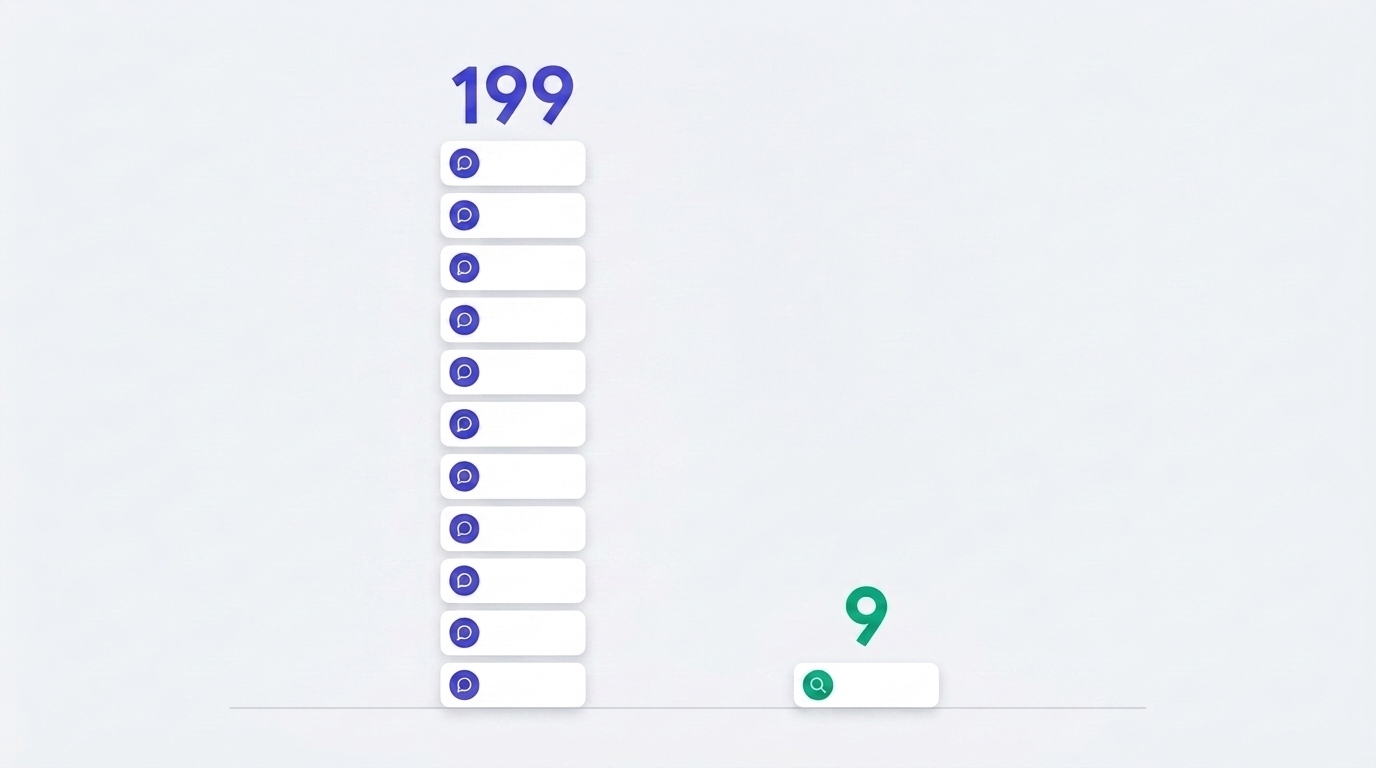
ChatGPT Sent Us 199 Visitors. Google Sent 9.
Same site, same 28 days, two very different channels. Here are our real numbers, how we measured them, what we think earned the citations, and the caveats that stop this from being a universal law.
See what AI says about your store
We published our own AI referral numbers because we run the same visibility tracking for ecommerce stores — mentions, citations, and who wins instead.
See how AI Visibility worksWe build a tool that measures whether AI assistants cite your site, so we point it at our own domain. Between July 11 and August 7, 2026, AI assistants sent 199 visits to searchmention.com. Over the exact same 28 days, Google organic search sent 9 clicks — from 17,165 impressions.
We are not publishing this because 22x is a law of nature. It isn't, and we explain below why our numbers are flattering. We are publishing it because almost nobody shares first-party AI referral data, the entire category is arguing about whether AI search matters using screenshots and vibes, and the only honest contribution we can make is our own measured numbers with the methodology attached.
If you take one thing from this: the traffic is probably already arriving and you probably aren't counting it. AI referral visits land in most analytics setups as ordinary referral traffic from an unfamiliar hostname, and they get ignored.
TL;DR
- 199 AI assistant visits vs 9 Google clicks over the same 28 days on our own domain.
- ChatGPT was 194 of the 199 — a 97% share. Claude, DeepSeek and Gemini were rounding errors.
- Google showed us 17,165 times and produced 9 clicks, a 0.05% click-through rate, because our pages sit at position 38–84.
- Publishing more didn't help: 37,053 blog impressions over 90 days produced 13 clicks.
- Our niche is AI-heavy and the absolute numbers are small, so treat the ratio as an illustration, not a benchmark.
- Measure your own by splitting referrals by hostname, and count AI crawlers separately from humans.
The numbers, side by side
One site, one window: July 11 to August 7, 2026. The AI column comes from our own referral tracking; the Google column comes from Search Console.
| Source | Visits / clicks | Times shown |
|---|---|---|
| ChatGPT | 194 | not disclosed |
| Claude | 2 | not disclosed |
| DeepSeek | 2 | not disclosed |
| Gemini | 1 | not disclosed |
| All AI assistants | 199 | — |
| Google organic | 9 | 17,165 |
The asymmetry in that last column is the part worth sitting with. Google told us precisely how many times it showed us something — 17,165 — and 9 people clicked. The AI assistants tell us nothing about how often they considered us and quietly delivered 22 times the visitors. One channel gives you a detailed report on your own irrelevance; the other gives you visitors and no explanation.
That opacity is the actual product problem in AI search. There is no Search Console for ChatGPT, so the only way to see the equivalent of impressions is to ask the models your buyers' questions yourself and record what they say.
How we measured it (and what we excluded)
A number like this is only worth as much as its definition, so here is ours exactly.
What counts as an AI visit. A real browser requested a page on searchmention.com and the referrer was an AI assistant hostname — chatgpt.com, chat.openai.com, claude.ai, perplexity.ai, gemini.google.com, and similar. That means a human read an AI answer, saw us named in it, and clicked through.
What we excluded. Crawler traffic. GPTBot, OAI-SearchBot, PerplexityBot and friends identify themselves by user-agent and get counted as bot visits in a separate bucket. This distinction matters enormously, because bot hits are the easy number to inflate — a single crawl pass can generate hundreds of requests. None of them are in the 199. Conflating crawlers with humans is the most common way AI traffic claims get overstated, including by tools that should know better.
The Google side. Search Console clicks and impressions for the same property over the identical date range, no filters. Comparing a 28-day AI window against a 90-day Google window would have made the story look better and the analysis worthless.
Nothing here requires our product. Referrer hostnames are in your server logs and in GA4 already. We built tracking into our AI Traffic feature because we wanted the referral-versus-crawler split without maintaining regexes, but the raw signal is free and sitting in your logs right now.
The part that stings: 37,053 impressions, 13 clicks
We did the thing everyone tells you to do. We published blog posts. Over 90 days those posts collected 37,053 Google impressions and 13 clicks. A 0.035% click-through rate.
The reason is unglamorous: nearly every page sits between position 38 and 84. Nobody scrolls to position 70. Our single highest-impression page had 5,690 impressions at average position 70.9 and zero clicks — thousands of people searched something we theoretically address, Google showed us, and not one person went four pages deep to find out.
We also learned that volume was never the lever. Some of those pages were machine-generated in bulk; 31 of them produced 24,451 impressions and 10 clicks, while our 7 hand-written posts produced 12,602 impressions and 3 clicks. Both formats converted at essentially the same dismal rate. Publishing more pages did not move the outcome, because the problem was never page count.
Here is the twist that changed our plans. Those impressions prove the demand is real — people are searching these terms in volume. Our best-performing query cluster is some variant of "ChatGPT rank tracker," roughly 1,291 impressions in 28 days across four phrasings, all at position 50 or worse, all with zero clicks. That is not a content-volume problem. That is a "we have never written anything that deserves the click" problem, on a query we should own.
Why 199 AI visits beat 9 Google clicks by more than 22x
The raw ratio understates it, because the two kinds of visitor are not comparable.
Someone who clicks a Google result at position 12 is still shopping. They have ten other tabs, they are comparing, and you earned the click by being adjacent to what they wanted. Someone who arrives from an AI answer has read a paragraph explaining what you do and why you were worth naming, and often a comparison against two alternatives. The filtering happened before the click. They arrive knowing what you are.
The trade-off is brutal and worth stating plainly: there is no position 11 in an AI answer. Ranking eleventh on Google still earns impressions and the occasional click. Being the fourth-best option for a prompt that names three earns you exactly nothing. AI visibility is closer to winner-take-most than search ever was, which is why the distribution of our own referrals is 97% ChatGPT and a rounding error everywhere else.
It also decays differently. A page that ranks keeps ranking until someone outranks it. A page that gets cited keeps getting cited until the model's picture of your category updates — and when it updates, you can lose every prompt at once with no ranking drop to warn you.
What we think earned the citations
Honest caveat first: we cannot prove attribution. Referral data tells us a visit came from chatgpt.com, never which question triggered it. What follows is a hypothesis from running our buyers' questions against the models and seeing which of our pages come back.
Pages shaped like answers to specific questions. Our cited pages are the ones with a narrow question in the title and a direct answer in the first paragraph. Pages built to rank for a keyword — broad, hedged, "ultimate guide" shaped — do not come back in answers. Models quote sentences, not documents, so a page needs quotable sentences that stand on their own out of context.
Specific numbers. Assistants reach for concrete claims, and a sentence containing a figure and a date survives summarization better than an adjective. "Position 70.9 with zero clicks" is quotable. "Poor visibility" is not. This post is partly an experiment in that principle.
Honest comparisons that name competitors. Our tools comparison names alternatives and says who each one is genuinely better for. When someone asks an assistant to compare options, a page that only pitches one product is useless to the model and gets skipped.
Being crawlable at all. Unexciting but disqualifying. If GPTBot and OAI-SearchBot cannot fetch your pages, none of the above matters — and plenty of stores block them by accident through a theme default or a security plugin. Our own site scores 85 on the readiness check we sell, which is a reminder that being technically clean is table stakes, not an advantage.
Four reasons not to over-read our numbers
If we skipped this section you should trust the rest less.
- Our niche is the most AI-heavy niche there is. People searching for AI visibility tools are disproportionately people who ask ChatGPT things. A plumbing supplier's ratio will look nothing like ours.
- The absolute numbers are small. 199 versus 9 is a real difference in kind, not a statistically robust finding. At this scale a single Reddit thread or one AI answer changing its mind moves the whole figure.
- Our Google performance is bad, which flatters the comparison. A site with genuine search authority would have a far healthier Google column. Part of our 22x is AI strength; part is simply being nobody on Google.
- Some Google impressions were never ours to win. A chunk of those 17,165 came from posts about Asian search engines and B2B search engines — topics with no relationship to our product, published in a bulk-content phase we have since ended. They inflate impressions and would never have converted.
What survives all four caveats is narrower and still worth acting on: a site with almost no Google traction received 199 visits from AI assistants in a month, and would not have known unless it was looking.
How to check your own numbers this week
Three steps, in increasing order of effort. The first two are free and use tools you already have.
1. Split your referrals by hostname. In GA4, open Reports → Acquisition → Traffic acquisition and look at Session source, or build an exploration on Page referrer. Search for chatgpt.com, perplexity.ai, claude.ai, gemini.google.com and copilot.microsoft.com. Most sites have never looked and are surprised by what is already there.
2. Check that the crawlers can get in. Grep your access logs for GPTBot, OAI-SearchBot, PerplexityBot and ClaudeBot. Zero hits usually means blocked rather than uninteresting. Our guide to allowing the OpenAI crawlers covers the robots.txt rules, including the Shopify theme quirk that silently blocks them.
3. Find out what the models actually say about you. This is the part referral data cannot answer, and it is the number that predicts everything else. Ask the questions your buyers ask and record whether you are named — manually is fine to start. Our citation tracking guide covers the manual workflow across engines, and the Perplexity walkthrough is the easiest engine to audit by hand because it always shows its sources.
For our own site that third number is currently 33% — we are named in roughly a third of the buyer questions we track. Which is a strange thing to publish, and also the entire point: we would rather tell you our real number than imply we have solved this. If you sell products rather than software, the same logic applies at the SKU level, and our Shopify AI search checklist is the product-page version of this work.
What we changed after reading our own data
Three decisions, so this is a report rather than a brag.
We stopped publishing in bulk. The machine-generated experiment is over. It produced 24,451 impressions, 10 clicks, and a lot of pages competing with each other — at one point five of our own URLs were fighting over the same query. We are deleting the ones aimed at the wrong audience and rewriting the handful that sit on real demand, keeping the URLs.
We rewrote our homepage around a question instead of a signup form. Most of our AI referrals land on the homepage, arriving from an answer that named us, with no reason yet to trust us. Asking those visitors to create an account was the wrong first move.
We made the check free and instant. You enter a domain, we run a real buyer question through ChatGPT, and you see who got recommended and which pages the answer came from. No account. We would rather show you the gap than describe it.
Frequently asked questions
How much traffic does ChatGPT actually send to a website?
It depends entirely on whether AI answers cite you, not on how much content you publish. On our own site ChatGPT sent 194 visits in 28 days between July 11 and August 7, 2026, while Google organic sent 9 clicks from 17,165 impressions. Our niche is unusually AI-heavy, so treat the 22x ratio as an illustration rather than a benchmark. The reliable way to know your own number is to measure referral traffic by referrer hostname.
How do I measure AI referral traffic?
Look for the AI assistant hostnames in your referrer data: chatgpt.com and chat.openai.com for ChatGPT, perplexity.ai for Perplexity, gemini.google.com for Gemini, claude.ai for Claude, and copilot.microsoft.com for Copilot. In GA4, build an exploration on Session source / medium or filter Page referrer by those hosts. Count these separately from AI crawler hits (GPTBot, OAI-SearchBot, PerplexityBot, ClaudeBot), which appear in server logs by user-agent and are not human visits.
Why does AI traffic convert better than search traffic?
Because the filtering happens before the click. A search results page shows ten options and the visitor is still comparing; an AI answer usually names two or three and the visitor has already read a summary of why. People who arrive from an AI answer have effectively been pre-qualified by the model, so they tend to land deeper in the funnel. The trade-off is volume: you either get named in the answer or you get nothing, with no equivalent of ranking eleventh.
Do Google impressions still matter if nobody clicks?
Impressions confirm the demand is real, but they do not pay. Our blog collected 37,053 impressions and 13 clicks over 90 days, a 0.035% click-through rate, because almost every page sat between position 38 and 84. Impressions at those positions tell you a query has volume and that you are not a credible answer for it yet. That is useful as a research signal and worthless as a traffic channel.
Can you see which prompt caused an AI assistant to cite you?
Not from referral data. The referrer only tells you the visit came from chatgpt.com, never which question produced it. The only way to connect citations to prompts is to maintain a list of the questions your buyers ask, run them against the models on a schedule, and record which answers name you. That is the gap dedicated AI visibility tools fill.
Next steps
- Run a free AI readiness scan to see technical blockers that keep you out of answers.
- Filter your GA4 referrals by the AI hostnames above to find traffic you are already getting.
- Confirm the AI crawlers can reach you with the robots.txt guide.
- Set up ongoing measurement using the citation tracking guide.