How Google AI Overviews Work (2026)
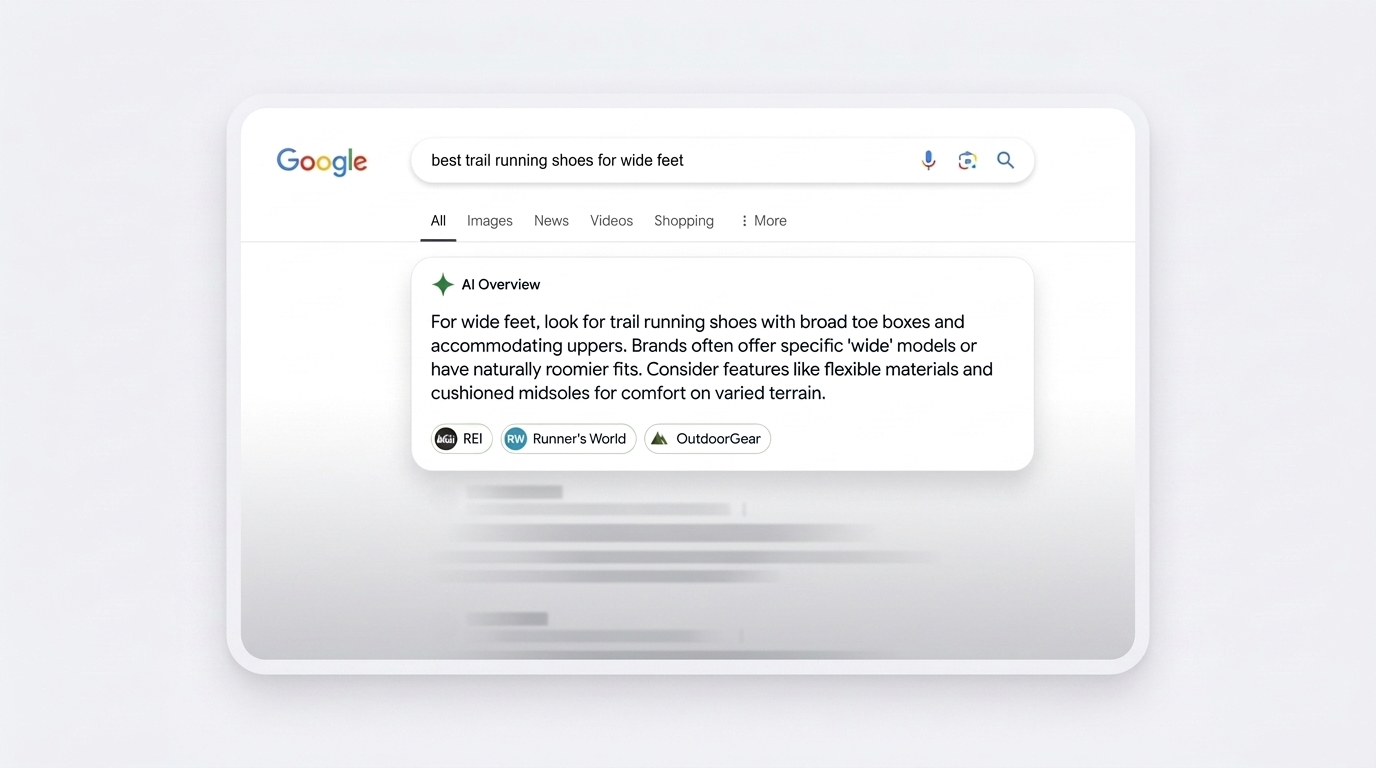
A customized Gemini model writes a short answer on some Google results, grounded in Search ranking and related “fan-out” queries — then links the pages that support it.
Can Google even use your pages?
AI Overviews only cite pages that are indexed and snippet-eligible. A free readiness scan checks crawler access and schema before you chase citations.
Scan My Site FreeHow do Google AI Overviews work? Google runs a customized Gemini model on top of its normal Search systems. When it thinks a generated snapshot will help, the model issues related searches, pulls pages from the regular index, and writes a short answer with supporting links. It is a Search feature, not a chatbot.
That is why a page can show up in an Overview without ranking in the top 10 for the query you typed. The model is assembling an answer from several related searches, not copying the blue links under the box.
This is the mechanism guide. For tactics across ChatGPT, Gemini, and Perplexity, use how to rank in AI search. To measure citations after you ship, use how to track AI search citations.
TL;DR
- Not every search gets one. Google only shows an Overview when it thinks generative AI adds value and quality is high enough.
- Same index as classic Search. No secret AI index. Indexed + snippet-eligible is the ticket in.
- Fan-out is the twist. Gemini runs extra related queries, so citations often come from a neighboring SERP.
- Ranking helps; it does not guarantee a citation. Ahrefs saw top-10 overlap fall from 76% (Jul 2025) to 38% (Mar 2026).
- Skip the GEO hacks. Google Search ignores
llms.txt. Blocking Google-Extended does not opt you out of Overviews.
What an AI Overview actually is
An AI Overview is the generated snapshot at the top of some google.com results: a short answer, supporting links, sometimes images, video, products, or local details. Ads stay in labeled slots. Google treats it as a core Search feature, like a knowledge panel — you cannot turn it off, though the Web filter hides it after you search.
Google’s own numbers (June 2026): 2.5 billion monthly users for AI Overviews, and 1 billion+ for AI Mode, the conversational Search tab. As of January 2026, Gemini 3 is the global default model for Overviews. On mobile you can tap Show more, ask a follow-up, and land in AI Mode with the original query as context.
| Product | Where it lives | What it does |
|---|---|---|
| AI Overviews | Classic Google SERP | Snapshot + links, only when Google thinks it helps |
| AI Mode | Search tab / follow-up from an Overview | Deeper conversation, heavier fan-out, more queries answered |
| Gemini chat | gemini.google.com | Separate chatbot. Different retrieval and citations |
Google is explicit that Overviews and AI Mode may use different models and techniques, so the same query can cite different pages in each. If you only screenshot the SERP box, you are not measuring AI Mode.
The five steps, in order
This is what Google has published in Search Central and its generative AI optimization guide. Scoring among eligible pages is the part they still will not describe.
1. Triggering — should this query even get a box?
Overviews do not fire on every search. Google shows them when generative AI is “especially helpful” and quality looks high enough. They try not to show on highly sensitive, explicit, dangerous, or “data void” queries (topics with little good web coverage). Liz Reid, VP of Search, has said the bar moves as models get stronger — more queries qualify over time, but a bad Overview still should not ship.
Independent measurement (not Google’s claim): Semrush’s 10 million-keyword study saw Overviews on 6.5% of queries in January 2025, 24.6% in July, then 15.7% in November. Informational queries still dominate, but commercial, transactional, and even navigational queries grew fast through 2025. Shopping and real estate stay relatively unsaturated — Google already has Shopping and Local packs there.
2. Query fan-out — extra searches you never typed
This is the distinctive mechanic. Google’s definition: a set of concurrent, related queries generated by the model to fetch more results. Their example: “how to fix a lawn that's full of weeds” fans out into herbicides, chemical-free removal, and prevention.
If you sell a product, think in sub-questions. A page that answers “how to wash merino without shrinking” can get cited for “best merino base layers,” even if it never ranked for that head term. Pages that rank for fan-out queries have been measured as far more likely to be cited than pages that only rank for the original query.
3. Retrieval — ordinary Search, plus Google’s other graphs
Google calls this retrieval-augmented generation, or grounding. Core ranking systems fetch up-to-date pages from the same Search index used for blue links. There is no separate AI index. The model can also pull Knowledge Graph facts and shopping data (Google has cited 50 billion+ products for AI Mode).
To be eligible as a supporting link, a page must be indexed and eligible to show a snippet. That is the whole technical bar. No special schema. No AI text file.
4. Synthesis — Gemini writes the snapshot
Gemini reads the retrieved pages and writes the Overview. Google says Overviews are built to surface information backed by top web results, so they “generally don’t hallucinate” the way a naked chatbot might. They still can be wrong. Google’s own help page says Overviews “can and will make mistakes.”
Extra brakes on Your Money or Your Life queries (health, finance): a higher quality bar, and copy that often tells people to seek an expert. SpamBrain plus extra anti-spam aimed at Overviews try to keep junk out. SafeSearch and featured-snippet-style policies apply.
5. Links — the part you can win
The Overview shows clickable sources that support the claims. Google has been adding more inline links and website previews to push people off the snapshot. Getting cited is eligibility plus being the useful passage for one of those fan-out sub-questions. Getting the click is a second, harder problem — more on that below.
How does Google decide which sites to cite?
How does Google decide which sites to cite in AI Overviews? Officially: core ranking and quality systems retrieve candidates; the model then links pages that support the generated claims. Unofficially: nobody outside Google has the scoring formula. Treat any “AIO ranking factor list” as industry inference.
What Google has confirmed:
- Indexed + snippet-eligible. Full stop on extra technical requirements.
- Unique, non-commodity content beats recycled roundups. First-hand reviews beat “7 tips anyone could write.”
- Structured data is not required for Overviews. Keep using it for rich results; do not invent special AI schema.
- Merchant Center feeds and Google Business Profile can feed product and local facts into generative responses.
- A Search Console toggle (default: include) can exclude a whole property from generative features without tanking classic Search.
Do I need to rank on Google to appear in AI Overviews? Ranking helps. It is not a ticket. Ahrefs measured the share of cited URLs that also sat in the organic top 10 at 76% in July 2025 and 38% in March 2026 — same publisher, same metric. Their read: Gemini 3 fans out more aggressively, so more citations come from related SERPs. seoClarity found ~90% of Overviews still cite at least one top-10 page, while many of the other links do not. Position 1 still gets cited far more often than position 20. Cover the query’s neighborhood, not only the head term.
Five things you can ignore
Google’s May 2026 optimization guide is unusually blunt about GEO folklore. From Google Search’s point of view, optimizing for Overviews is still SEO.
| Myth | What Google says |
|---|---|
llms.txt |
Google Search ignores it. Fine for other tools; not a ranking lever here. |
| Chunking pages into tiny AI bites | Not required. Write for humans. There is no ideal page length. |
| Rewriting copy “for AI” | Models already handle synonyms. Long-tail keyword stuffing is wasted work. |
| Fake mention campaigns | Treated like spam. Off-site mentions only help if they are real, high-quality pages. |
| Blocking Google-Extended | Limits some Gemini training. Does not remove you from AI Overviews. Use nosnippet / Search Console exclude instead. |
Do Overviews steal clicks?
Google’s public line: people search more, remaining clicks are “higher quality” (fewer bounce-backs), and aggregate outbound clicks are “relatively stable.” They have not published the underlying figures.
Independent measurements are harsher on informational queries. Pew Research (March 2025, 68,879 real searches) found users clicked a traditional result on 8% of visits when an AI summary appeared versus 15% without. Links inside the Overview were clicked on about 1% of visits. Google called the queryset skewed. Seer Interactive reported a 61% organic CTR drop on informational AIO queries from June 2024 to September 2025.
Both stories can be true: fewer total clicks on definitional SERPs, and the clicks that remain are more qualified. If you sell SKUs, the Overview is a discovery layer. The purchase still happens on a product page — which is why Merchant Center accuracy and unique product copy still matter. For the store-side diagnosis, see why products don’t show up in ChatGPT (the same crawl/schema/feed failures kill Overview eligibility).
What to do if you want to get cited
Google’s confirmed levers are boring, which is why they still work:
- Stay crawlable and snippet-eligible. Googlebot must reach the page.
noindexornosnippettakes you out of Overviews. Run a free AI readiness scan if you are not sure. - Write the sub-question, not only the head term. Fan-out rewards pages that fully answer related how-tos, comparisons, and constraints. One strong page that covers the neighborhood beats ten thin variations — scaled doorway pages violate spam policy anyway.
- Put unique facts on the page in text. Specs, prices, first-hand tests, return policies. JavaScript-only content is a common miss. Structured data should match what humans see.
- Keep Merchant Center and Business Profile honest if you sell products or have a local footprint. Generative responses reuse that data.
- Measure the right surface. Search Console’s Generative AI report (rolled out worldwide 31 Aug 2026) shows impressions in Overviews and AI Mode. It is visibility, not clicks. For ChatGPT / Perplexity citations, you still need prompt monitoring — start with citation tracking and AI Visibility.
Shopify-specific crawl and schema gaps are covered in our 12-step Shopify checklist. “Rank” inside a chatbot is a different metric than a SERP box — that distinction is in what ChatGPT rank tracking actually means.
Frequently asked questions
How do Google AI Overviews work?
A customized Gemini model plus Search ranking and the Knowledge Graph. When Google thinks a snapshot will help, the model runs related searches (fan-out), retrieves pages from the normal index, and writes a short answer with supporting links. It does not fire on every query.
How does Google decide which sites to cite in AI Overviews?
Eligibility is indexed + snippet-eligible. Retrieval uses core ranking and fan-out, so links often come from related sub-queries. Google has not published the formula that picks winner passages among those candidates.
Do I need to rank on Google to appear in AI Overviews?
It helps. It is not required. Top-10 overlap of cited URLs fell from 76% to 38% in Ahrefs’ own studies between July 2025 and March 2026. Cover related questions, not only the head keyword.
Is this the same as Gemini chat?
No. Overviews live on Google Search. Gemini chat is a separate app. AI Mode is the conversational Search tab — a sibling of Overviews, not Gemini.google.com.
Does llms.txt help?
No. Google Search ignores it. Blocking Google-Extended also does not opt you out of Overviews.
Next steps
- Scan crawler access and schema with a free AI readiness check.
- Apply the on-page playbook in how to rank in AI search.
- Track whether you actually get cited — citation methods, then AI Visibility if you want prompts on a schedule.